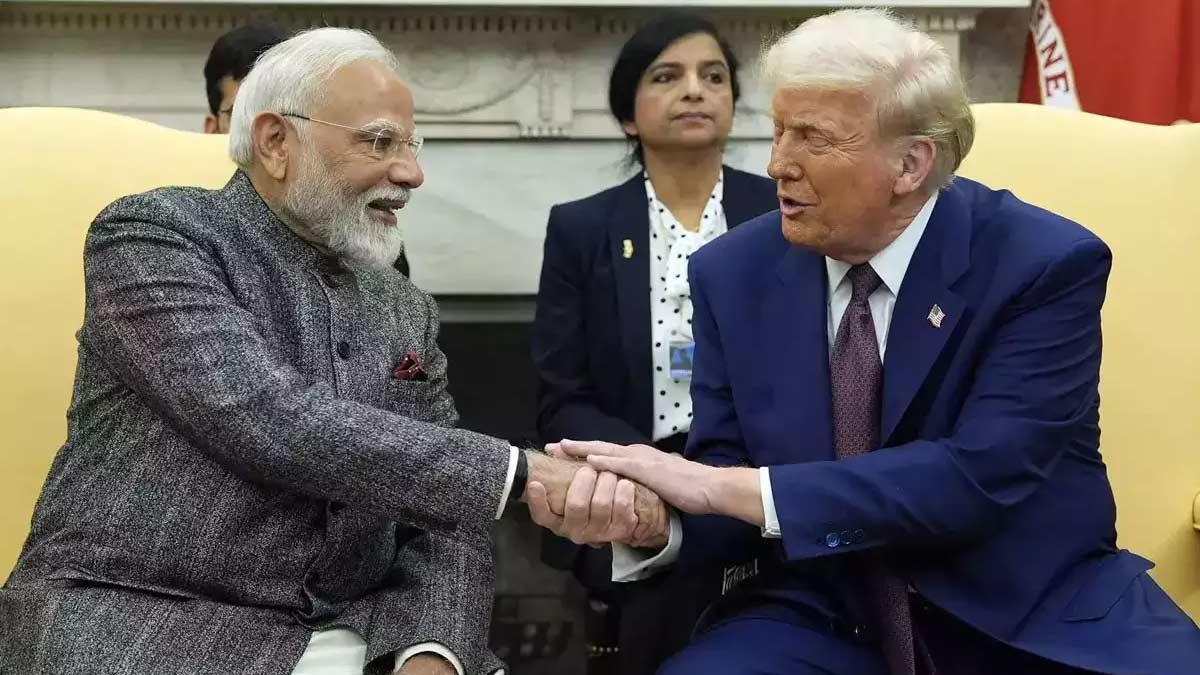


US President Donald Trump attempted to call Indian Prime Minister Narendra Modi over phone at least four times in recent weeks, Germany's Frankfurter Allgemeine reported. Modi reportedly refused to answer the calls. The Mainz newspaper attributed this to the "depth of his [Modi's] anger, but also his caution."
These calls were made against the backdrop of tensions, with the Trump administration slapping 50% tariffs on India—the highest it imposed on any nation besides Brazil.
It is unclear whether the recent downfall in relations would transform into an obstacle in the complex, carefully nurtured, Indo-American relationship over the past 25 years. The relationship lost momentum when Trump criticized India for it's trade surplus and imposed sanctions on New Delhi for buying crude oil from Russia.
"FAZ claims that Trump tried to call Modi four times in recent weeks but that Modi refused the calls," posted Thorsten Benner, Co-Founder and Director of the Berlin-based Global Public Policy Institute, on X, sharing a copy of the newspaper report.
FAZ is an acronym for Frankfurter Allgemeine Zeitung, with Zeitung meaning "newspaper" in German.
"I don't care what India does with Russia. They can take their dead economies down together," Trump remarked July 31.
Modi indirectly responded to Trump's statement about a "dead economy" on August 10 and said India was going to be among the top three economies in the world.
The news outlet noted that Trump's tactic was frequently to play on other countries' dependence on the US market, but Modi "resisted this" during Trump's first term, maintaining a collaborative relationship with Trump while protecting India's economic priorities.
FAZ also noted the surprising element of this situation where Trump kept trying to persuade Modi to back down.
"The fact that the Indian still refuses to talk demonstrates the depth of his anger, but also his caution", the report by the German newspaper stated.
FAZ then explained why Modi was understandably careful.
It explained that Trump had renegotiated an earlier trade deal between the United States and Vietnam that had taken delegations days to format, with just a single telephone call, to General Secretary To Lam .
"Modi does not want to be caught in the net of undoing all that," FAZ stated, relating to the need for caution.
"America's strategy isn't working," says Mark Frazier. "The American concept of an 'Indo-Pacific' alignment, in which India would play a central role in the US's containment of China, is collapsing." According to Frazier, co-director of the India-China Institute at the New School in New York, India never intended to commit to siding with the US against China.
FAZ also pointed out that Trump's real estate ventures in India have attracted controversy. Near the Indian capital of Delhi, the Trump family company built luxury towers in his name. FAZ reported that the 300 apartments — with prices up to twelve million euros — sold out in one day in mid-May.
However, tensions emerged on the Indian side when Trump declared that he alone achieved a ceasefire in the recent India-Pakistan military conflict.
"The fact that Trump announced he would develop oil reserves with Pakistan, which India would then purchase from its arch-enemy, didn't make matters any better", the report stated. "Even the fact that Trump hosted Pakistan's army chief, Asim Munir, for a working dinner in the Oval Office was perceived in India as a provocation," it added.
FAZ was noting that long-term tensions seem to be abating in New Delhi. Since meeting Xi last year, Modi has said that he has felt, above all, "respect."
This week he is scheduled to attend the Shanghai Cooperation Organization summit in Tianjin, which raises concerns over whether Trump is gently nudging India closer to China.
"India needs China more than China needs India," says Frazier. "India’s shift is strategic, not just a response to US tariffs. With the US retreating, India and China share interests in global influence and industrial growth. For China, India is key to boosting its global economic and geopolitical position".
Modi's conversation with Trump was at the request of the US President, according India’s Ministry of External Affairs (MEA). Although it was expected that the two would meet on the sidelines of G7 Summit in Canada, Trump left early for the US.
"After this, at the request of President Trump, both leaders spoke over a phone call today (July 17). The conversation lasted approximately 35 minutes," the MEA said in the statement released on June 18.
The MEA said during the call, Trump expressed his condolences over the April 22 terrorist attack in Pahalgam and reiterated his assistance towards counter-terrorism.
"This was the first conversation between the two leaders since [the attack and Operation Sindoor]," the MEA said, adding "Hence, Prime Minister Modi spoke in detail about Operation Sindoor with President Trump."
Trump also said his mediation and trade proposals resulted in India and Pakistan agreeing to a ceasefire in May after four days of fighting, however New Delhi has rejected the claim on multiple occasions.
"Prime Minister Modi clearly conveyed to President Trump that at no point during this entire sequence of events was there any discussion, at any level, on an India-US Trade Deal, or any proposal for a mediation by the US between India and Pakistan," the MEA said of the June 17 call between the two leaders.
"The discussion to cease military action took place directly between India and Pakistan... and it was initiated at Pakistan's request. Prime Minister Modi firmly stated that India does not and will never accept mediation. There is complete political consensus in India on this matter," it stated.
Read also| India Issues Flood Warning to Pakistan on Humanitarian Grounds
Read also| ‘Because he doesn’t like him’: Trump Comments on Why Putin Might Not Meet Zelenskyy