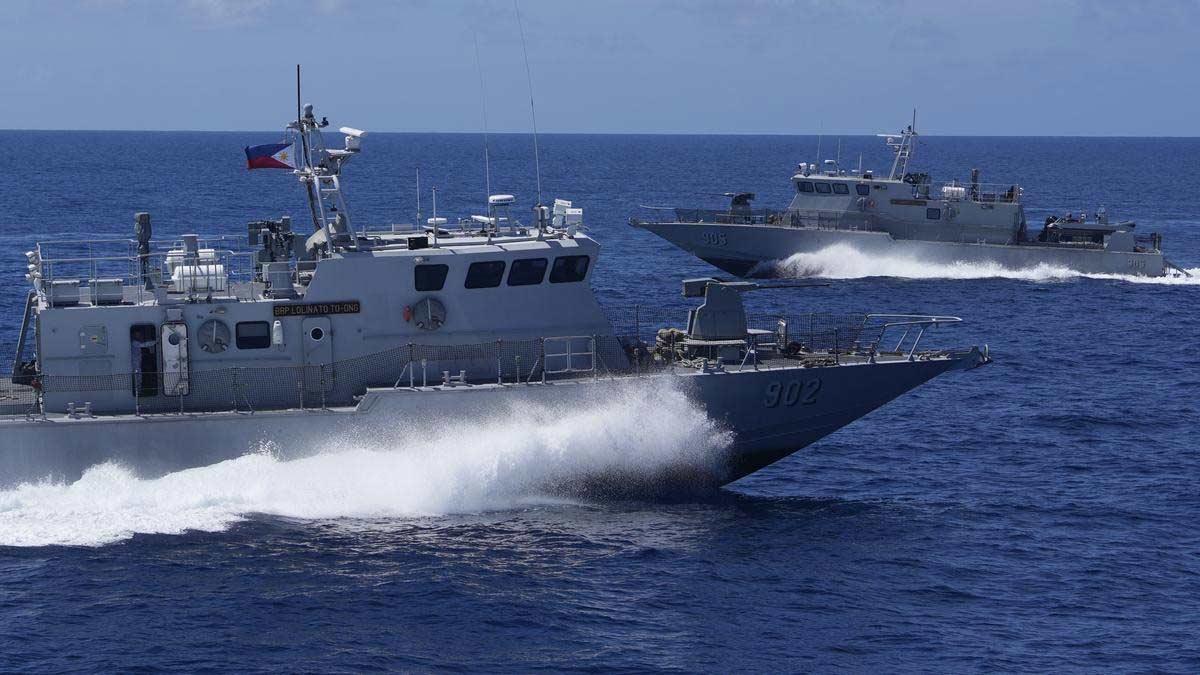


In a major military exercise that may further strain relations with China, India and the Philippines held their first joint naval sail and exercises in the disputed South China Sea.
The high-profile deployment highlights increasing security collaboration among the two democracies, both with their own territorial disagreements with Beijing.
AFP Chief of Staff Gen. Romeo Brawner verified on Monday (August 4, 2025) that the two-day sea exercises, which began Sunday (August 3), were "so far successful." He looked forward to future cooperation, adding that the Philippines wishes to join other joint exercises with the Indian armed forces.
To a query on whether China did anything during the exercise, Gen. Brawner responded, "we did not have any untoward incident but we were still tailed. We anticipated that already," without elaborating.
As quoted by the Philippine military, in past joint patrols with other foreign navies, Chinese coast guard and naval vessels have regularly tracked similar operations from a distance.
India and China have a long-standing and frequently strained border conflict in the Himalayas, which turned into an all-out war in 1962 and has seen various fatal battles in recent decades.
Meanwhile, China's expansive claims to much of the South China Sea—a body of water critical to global maritime commerce—have been the basis for recurring tension with several Southeast Asian countries, including most prominently the Philippines and Vietnam. Malaysia, Brunei, and Taiwan also claim interests in these waters.
In order to support its maritime presence and exercise freedom of navigation, the Philippines has conducted naval patrols in the disputed sea under the auspices of various key allies and strategic partners, such as the United States, Japan, Australia, New Zealand, and France. These operations serve to maintain international law and deter perceived Chinese aggression.
The Philippines has also opened up its sea and air patrols to the media, giving firsthand reports of what it terms as China's increasingly aggressive maritime behavior. China has frequently responded strongly to such actions. In a recent media briefing, Chinese Defence Ministry spokesperson Col. Zhang Xiaogang termed the Philippines as a "troublemaker" which is abetting outside forces, claiming that "China never wavers in its resolve and will to safeguard national territorial sovereignty and maritime rights and interests and will take resolute countermeasures against any provocations by the Philippine side."
In a statement last week, Gen. Brawner emphasized the need to prevent war through military modernization and enhanced alliances. "The way we do that is number one, the Armed Forces of the Philippines has to be made strong through modernisation and secondly, we have to join with like-minded countries and that's what we're doing with India," he said.
Speaking at a reception on board the Indian naval tanker INS Shakti, which arrived in Manila on Thursday (July 31), Gen. Brawner underscored the importance of the visit of the ship, terming it as more than ceremonial. It "sends a strong signal of solidarity, strength in partnership and the dynamism of cooperation between two dynamic democracies in the Indo-Pacific.
He welcomed the strengthening of Manila-New Delhi ties, reaffirming a mutual commitment "to maritime security, regional stability and a rules-based international order in one of the world's most geopolitically sensitive regions."
While this is going on, Philippine President Ferdinand Marcos Jr. left on Monday for a five-day state visit to India during which he is to meet Prime Minister Narendra Modi and other high-ranking officials. The visit is to further bilateral cooperation in areas of defense, trade and investment, agriculture, pharmaceuticals, and tourism.
Read also| Watch| 'Missiles being manufactured in UP': PM Modi's 'Brahmos' warning to Pakistan
Read also| ED Summons Anil Ambani for August 5 Interrogation, Issues Lookout Circular