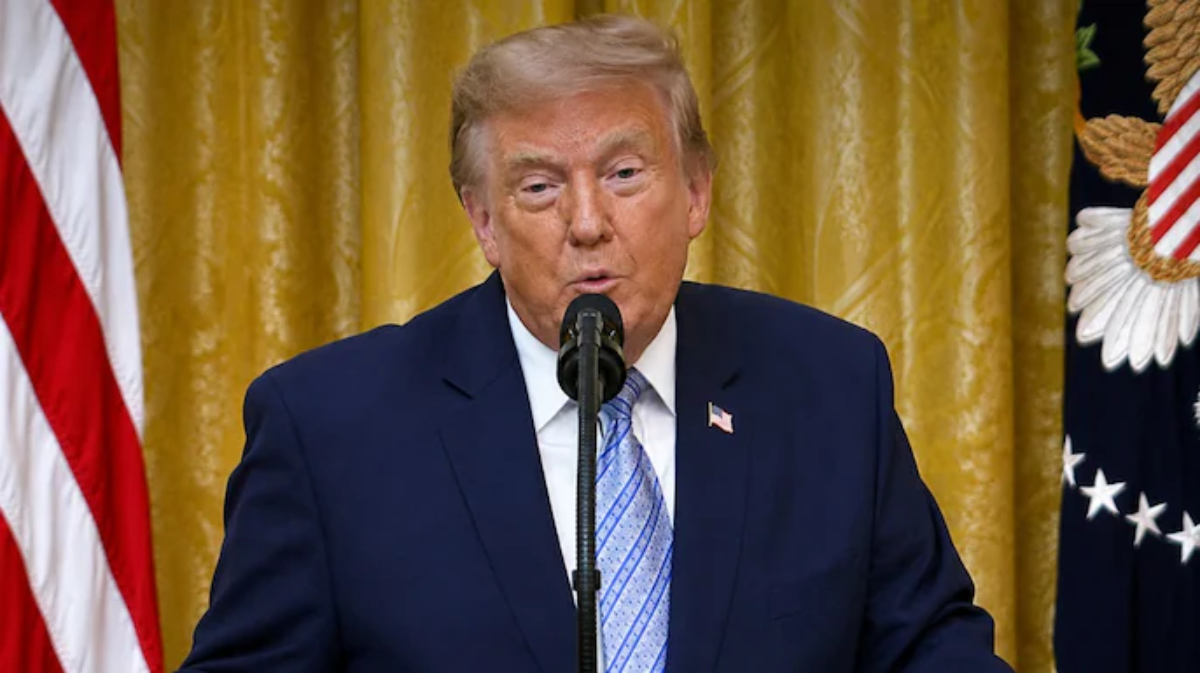
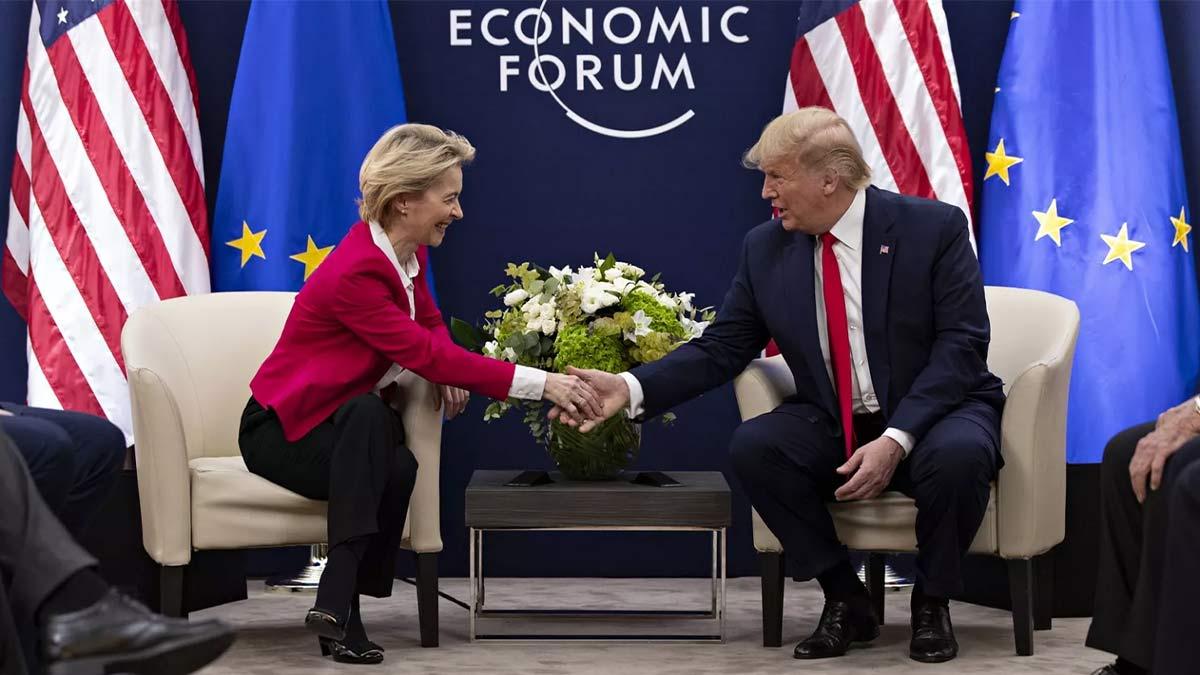


In a significant breakthrough intended to defuse escalating trade tensions, the European Union and the United States finalized what former President Donald Trump described as the "biggest-ever" trade deal on Sunday. The agreement closed a standoff on tariffs that threatened to spiral into a full-scale transatlantic trade war.
Trump announced this after a scathing meeting with European Commission President Ursula von der Leyen at his Scottish golf resort. He disclosed that a uniform 15% tariff would now be levied on EU exports to America.
Negotiated in about an hour, the deal came on the eve of the impending August 1 deadline, after which Washington had threatened to impose a 30% tariff on all European imports.
"We've come to an agreement. It's a great agreement for all. This is likely the largest agreement ever signed in any form," Trump declared in the announcement.
The new 15% tariff will apply across the board, covering important industries like automobiles, pharmaceuticals, and semiconductors—sectors crucial to the European economy.
As part of the agreement, Trump announced the EU had promised to purchase "$750 billion worth of energy" from the United States and committed an extra $600 billion in investments.
Von der Leyen confirmed the energy aspect of the agreement, noting that the EU would be importing large quantities of American liquefied natural gas, oil, and nuclear fuels in the coming three years. The efforts form part of the EU's overall drive to minimize reliance on Russian energy sources.
Speaking on behalf of all 27 EU member states at the negotiations, von der Leyen had pushed hard to protect a $1.9 trillion-a-year trading relationship in goods and services.
"It's a good deal," the president of the European Commission told journalists.
"It will bring stability. It will bring predictability. That's very important for our businesses on both sides of the Atlantic," she said.
The pact also contains exemptions from tariffs for a group of "strategic products," said von der Leyen, which include aircraft, certain chemicals, some agricultural products, and key raw materials.
She said the EU is also still in talks for more "zero-for-zero" deals, most notably for alcoholic drinks, which she hoped would be concluded in the near future.
Trump also assured that the EU—whose members have just reaffirmed pledges to increase defense spending under NATO—intends to purchase "hundreds of billions of dollars' worth of military hardware."
The EU had already faced various rounds of US tariffs since Trump returned to power, ranging from a 25% tariff on cars to a 50% tariff on aluminium and steel and a general tariff of 10% across the board. The threat to raise that overall tariff to 30% had prompted the bloc to request for immediate talks.
Tariff relief for key sectors, including car-making—Germany and France's top priority—had been a primary goal for EU negotiators.
"Fifteen percent is not to be dismissed, but it was the best that could be achieved," von der Leyen conceded.
Any deal will now have to be approved by EU member states. Ambassadors, who were on a visit to Greenland, were informed by the European Commission on Sunday and were due to reconvene after the announcement.
German Chancellor Friedrich Merz received the agreement warmly, stating that it avoided a "needless escalation in transatlantic trade relations."
Yet German industry reacted with mixed sentiments. The influential BDI industrial lobby forewarned "significant negative repercussions," while the VCI chemical trade association decried the agreement for keeping tariffs at a level that is still "too high."
The EU had been looking for a flexible deal on steel in the form of a tariff-free quota system. Trump, however, said existing tariffs on steel would not be altered. Von der Leyen subsequently maintained that times were changing and quoted, "tariffs will be reduced and a quota system will be established" for steel.
Although the 15% tariff well exceeds the past average US rate on European goods—around 4.8%—it roughly maintains the status quo, as there was already a 10% surcharge in place.
If negotiations collapsed, the EU had also prepared counter-tariffs on $109 billion (93 billion euros) of American goods, such as cars and planes, which were to be applied in stages from August 7.
Trump has prioritized reforming US trade relationships as a central component of his economic agenda, threatening mass tariffs for countries that do not negotiate new deals with Washington by the August 1 deadline.
Asked what the next trade target would be, Trump merely said: "This was the big one. This is the biggest of them all."
Read also| Trump Says Hamas ‘Wants to Die,’ Urges Israel to ‘Finish the Job’ in Gaza