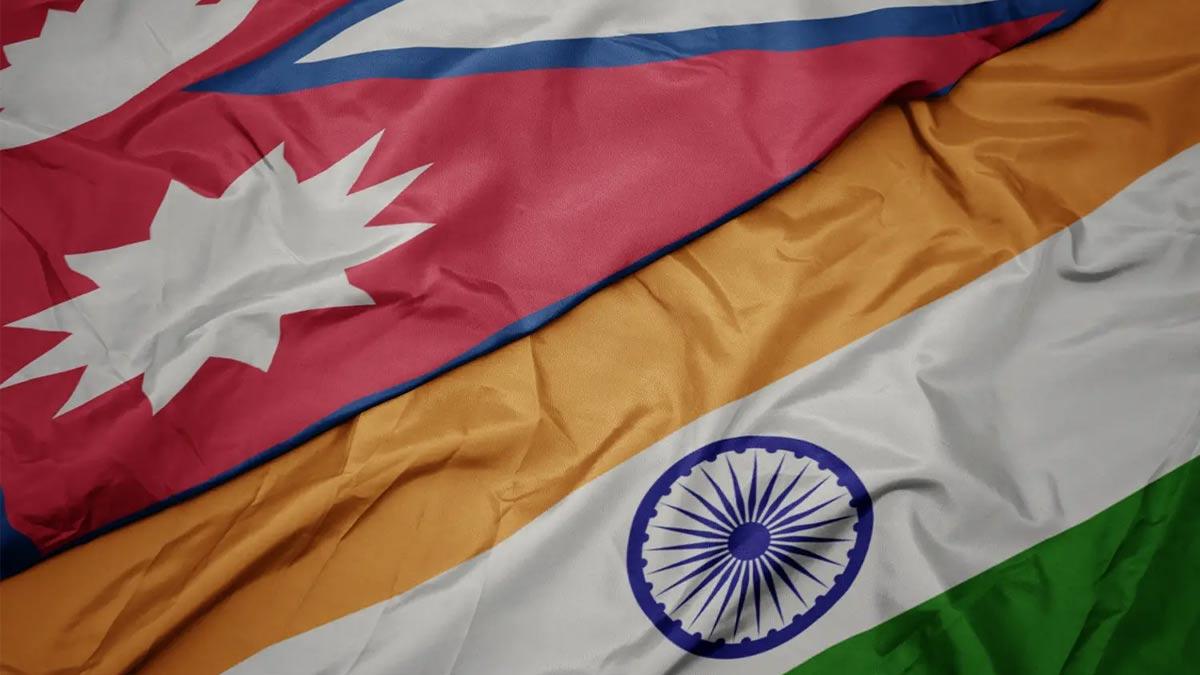


India on Wednesday rejected Nepal's complaint against reviving border trade with China through the Lipulekh Pass, terming Kathmandu's territorial claims as "unjustified, untenable, and not supported by historical facts."
The comment came amid criticism by Nepal's Ministry of Foreign Affairs of the reopening of India-China trade through the Himalayan route that runs through the Kalapani-Lipulekh-Limpiyadhura area. Nepal claims this land as part of its sovereign territory, relying on historical treaties and its own official maps.
Ministry of External Affairs spokesperson Randhir Jaiswal restated that India's position is "consistent and clear."
"We have seen the observations of Ministry of Foreign Affairs counsel of Nepal regarding resumption of India-China border trade via Lipulekh Pass. Our stance on this issue has been uniform and clear. India-China border trade via Lipulekh pass had been ongoing since 1954 and has been continuing for decades. This trade had been suspended in recent times due to Covid and other issues, and both sides have now consented to resume the trade," he said.
Mr Jaiswal characterized Nepal's move as a "unilateral act" and referred to the "artificial expansion" of its claims as "untenable." India insists that Lipulekh, Kalapani, and Limpiyadhura lie within its boundaries.
Replying to Nepal's protests, Mr Jaiswal said, "So far as claims of territory are concerned, our stand is that such claims are neither justified nor founded on historical facts and evidence. Any unilateral artificial expansion of territorial claims is not acceptable. India is willing to have constructive engagement with Nepal on fixing agreed outstanding issues of boundaries through diplomacy and dialogue."
Nepal has a border of more than 1,850 km with five Indian states - Sikkim, West Bengal, Bihar, Uttar Pradesh, and Uttarakhand.
Nepal, on Wednesday, reiterated that the disputed land is an integral part of the nation and is also evident in its official map.
"The Nepalese government is clear that Lipulekh, Limpiyadhura and Kalapani, located East of the Mahakali river, are unbreakable segments of Nepal. These are also officially included in the map of Nepal, included in the Constitution as well," stated the Nepal foreign ministry.
A joint statement issued on Tuesday following marathon talks in New Delhi between Chinese Foreign Minister Wang Yi, External Affairs Minister S Jaishankar, National Security Advisor Ajit Doval, and Prime Minister Narendra Modi reiterated that both countries had agreed to re-open border trade at three identified points: Lipulekh Pass, Shipki La Pass, and Nathu La Pass.
The Nepal foreign ministry announcement came amid questions by local media about the India-China move to revive trade through Lipulekh.
"It is an open fact that the Nepalese government has been urging the Indian government not to build or widen roads and engage in any type of activity like border trade in the area," said spokesperson Lok Bahadur Chhetri.
"It is also widely known that Nepal government had already notified the Chinese government that the region is within Nepalese territory," the statement further added.
"The Nepalese government is determined to settle the border dispute between the two nations through diplomatic means on the basis of past treaty-agreement, facts, map and other evidence in accordance with the spirit of friendly and good relations that exist between Nepal and India," it stated.
Nepal finalized the update of its political map on 18 June 2020 by adding the strategically important areas of Lipulekh, Kalapani, and Limpiyadhura by revising its Constitution.
Read also| Russia Extends 5% Oil Discount to India as Trump’s Tariff Dispute Escalates
Read also| NSA Doval to Wang Yi: India-China Relations Improving as Border Stays Peaceful