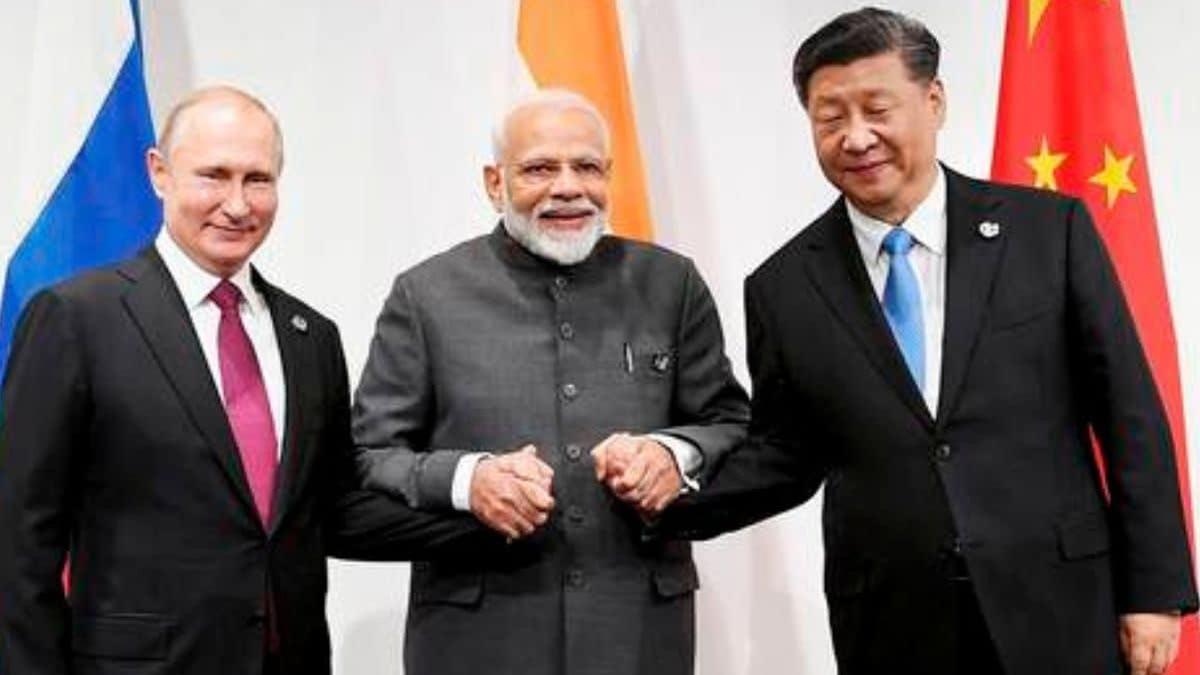


The much-discussed meeting between Prime Minister Narendra Modi, Russian President Vladimir Putin, and Chinese President Xi Jinping at the 2025 Shanghai Cooperation Organisation (SCO) Summit in Tianjin highlighted a rare moment of visible unity, according to a report released on Tuesday.
The trio’s handshakes, embraces, and Modi’s efforts to physically bring the leaders closer together became the defining visuals of the summit.
"The recent trilateral gathering of Putin, Xi, and Modi at the 2025 SCO Summit in Tianjin represents much more than diplomatic choreography or photo opportunities; it is a moment of consequence that throws the United States' twenty-five-year project of rapprochement and deepening partnership with India into sharp relief," a report in ‘One World Outlook’ detailed.
"While US policy enters a phase of unpredictability and economic confrontation, the visible warmth and symbolism displayed among the leaders of Russia, China, and India underscore the risks of strategic complacency in Washington and the historic value of treating India as an unshakeable partner—not a bargaining chip," it added
Modi’s presence in China carried added significance, the report noted, as it marked his first trip in seven years — a period overshadowed by persistent Sino-Indian frictions, including the Ladakh standoff and curbs on trade and technology. In that context, the visible cordiality between the leaders conveyed a sharp message: while at a time when the US is relying on protectionist trade policies and tariffs, particularly against India, Eurasian powers are communicating their intention to go their own way.
The analysis stressed that, despite Western speculation, India’s role at the summit does not amount to aligning itself with Moscow or Beijing. Instead, New Delhi continues to safeguard its strategic independence, something underscored by Modi’s firm remarks on terrorism — a pointed signal to Pakistan, delivered in its presence.
The report also pointed to India's increasing international support on some of its key concerns such as Kashmir, presenting it as evidence that its historical non-alignment policy is still intact. That policy, it stated, is based on pursuing national interest and maximizing leverage in a volatile global order.
"Recent years saw breakthrough agreements on cybersecurity, advanced communications (COMCASA), and export controls, as well as new joint initiatives around semiconductor supply chains and clean energy. India’s demographic, economic, and technological potential is undeniable: with a population projected to surpass China’s, a youthful workforce, and ambitions to be the world’s next manufacturing hub, India is one of the few countries with both the scale and credibility to anchor a democratic order in the Indo-Pacific," the report noted.
"To treat India as a secondary power — or worse, to penalise it for hedging its bets amidst a more aggressive US-China rivalry — would be a costly strategic mistake," it further stressed.
Read also| Asia’s Future No Longer Dominated by a Single Superpower: Report
Read also| Federal Judge Declares Trump’s Troop Deployment to Los Angeles Unlawful