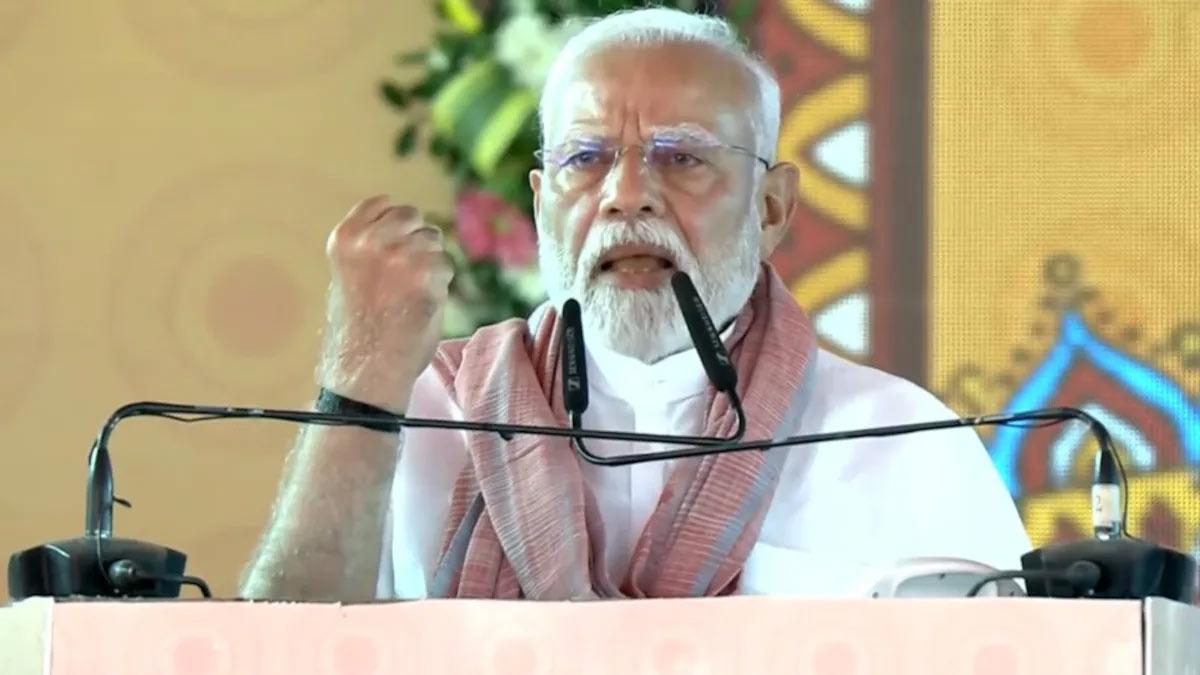


Prime Minister Narendra Modi on Monday called the recent Pahalgam terror attack "disgusting," terming it an attack on the conscience of humankind and an "open challenge to all nations who believe in humanity."
Addressing the Shanghai Cooperation Organisation (SCO) Summit in Tianjin, China, in which Pakistan's Prime Minister Shehbaz Sharif was also attending, Modi asked the member states to think about "whether the patronage of terrorism by certain nations is acceptable.
Speaking to leaders such as Chinese President Xi Jinping and Russian President Vladimir Putin, Modi called for solidarity in the bloc so that there is no confusion on counterterrorism. He explained that SCO members should clearly affirm that "double standards on terrorism are unacceptable."
Ahead of the summit, Indian officials had indicated that New Delhi expected a strong denunciation of cross-border terrorism in the joint communique. Modi’s trip marked his first visit to China in seven years and was also his first direct interaction with Sharif since hostilities in May, when India carried out military strikes against terrorist camps in retaliation for the Pahalgam attack.
Speaking in Hindi, the Prime Minister recalled the heavy toll terrorism has taken on India over the past four decades. “India has been suffering the brunt of ruthless terrorism for the last four decades. So many mothers lost their children and so many children became orphans,” he said, without directly naming Pakistan.
He further said, "Recently, we witnessed a very reprehensible style of terrorism in Pahalgam…This attack was not only a blow to the conscience of India, it was an open challenge to all nations, to every individual who believes in humanity. Under such circumstances, it is natural that the question would arise whether the open patronage of terrorism by some nations is acceptable to us?"
Urging collective determination, Modi emphasized, "SCO member states need to clearly and on one voice say that no double standards on terrorism will be accepted, and together oppose all kinds of terrorism."
The Prime Minister emphasized that security, connectivity, and opportunity are the three key pillars of the SCO, and peace and stability are the most vital foundations for development. “But terrorism, separatism, and extremism are big challenges in this path…No country, no society, no citizen can consider itself safe from it. That is why India has emphasised unity in the fight against terrorism,” he added.
He added that the SCO's Regional Anti-Terrorist Structure (SCO-RATS) has played a huge role in collective action against terror. "India initiated this year to combat al-Qaeda and associated terror groups by spearheading a 'joint information operation,'" Modi said, going on to say, “We also proposed to increase coordination and take joint steps against radicalisation. We have raised our voice against terror financing”.
On connectivity, Modi emphasized its potential to promote trade and confidence. He expressed support for initiatives like the Chabahar port and the International North-South Transport Corridor to enhance connectivity with Afghanistan and Central Asia. He warned, however, that connectivity cannot be allowed to undermine sovereignty and territorial integrity, an oblique reference to the China-Pakistan Economic Corridor. "This is also enshrined in the basic principles of the SCO Charter.". Connectivity that avoids sovereignty loses meaning and trust," he said.
Looking back at India's 2023 SCO presidency, Modi stated that New Delhi had emphasized cooperation and change by bringing in new topics such as innovation, digital inclusivity, empowerment of youth, and common Buddhist heritage. “To strengthen our people-to-people ties, I would like to make another suggestion today – a Civilizational Dialogue Forum should be created under the SCO. Through this, we can share our ancient civilisations, art, literature, and traditions on a global platform,” he suggested.
Unfolding India's internal reform programme, Modi stated that the nation has embraced the doctrine of "reform, perform and transform," which is opening new opportunities for growth and global cooperation. “This is also enshrined in the basic principles of the SCO Charter. Connectivity that by-passes sovereignty loses trust and meaning,” he further said.
His attendance at the SCO Summit and bilateral talks with Xi and Putin also coincided with increasing tension in India-US relations following Washington's imposition of tariffs due to India's purchase of Russian oil. Modi indicated that the SCO could potentially play a bigger role in creating a more equitable international order.
He stated the organisation can be "a guide to multilateralism and an inclusive world order" and cited its development with four new centres addressing challenges like organised crime, drug trafficking, and cyber security.
He also called for reforms in international institutions like the United Nations to more accurately represent the hopes of the Global South. “Keeping the aspirations of the Global South confined to outdated frameworks is a grave injustice to future generations. We cannot show the multi-coloured dreams of the new generation on old black-and-white screens,” he said.
Read also| Watch | Shehbaz Sharif Snubbed? Pakistan PM Gets Royal Ignore as Modi, Putin Walk Past