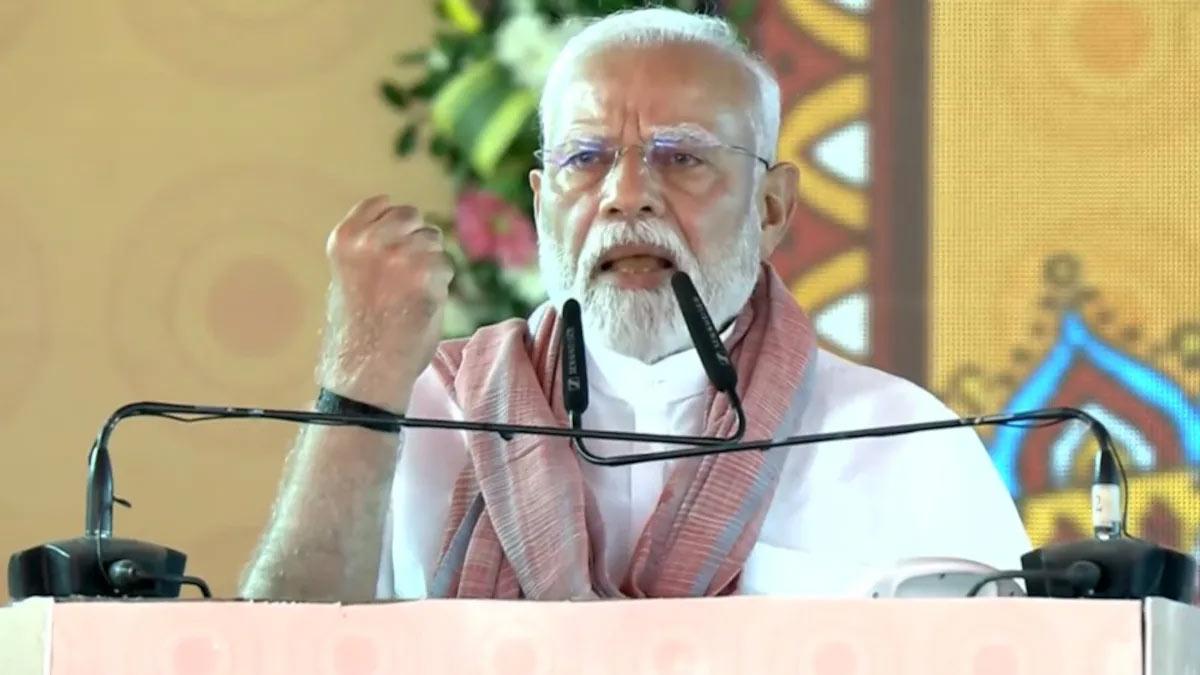


Prime Minister Narendra Modi on Saturday announced that India's foreign exchange reserves have reached an all-time high, a significant milestone in the financial prowess of the country.
Addressing The Economic Times World Leader Forum in New Delhi, he also highlighted that S&P Global Ratings has upgraded India's long-term sovereign credit rating for the first time in 20 years.
"We have missed some buses, but now India has decided that we would not only miss any bus also occupy the driving seat," Modi said.
India's forex reserves stood at $695.10 billion as of August 15, 2025, one of the highest ever, reflecting the resilience of the nation's economy in the midst of volatile global conditions. As per the Reserve Bank of India's (RBI) Weekly Statistical Supplement, this was a rise of $1.48 billion over the prior week, driven mostly by foreign currency asset gains.
This increase is following a $4.75 billion increase last week, indicating steady capital inflows and prudent management of reserves. Foreign currency assets, the biggest component of the reserves, rose by $1.92 billion to $585.90 billion due to valuation appreciation and a stable external balance.
Conversely, gold reserves fell slightly by $2.16 billion to $86.16 billion, driven probably by price movements in the international market and portfolio realignment. Special Drawing Rights (SDRs) with the IMF rose by $41 million, while India's reserve position with the IMF gained $15 million to $4.754 billion.
These advances provide a further boost to India's fiscal cushion, improving its ability to ride out global pressures. RBI Governor Sanjay Malhotra, following the recent monetary policy review, reaffirmed that the reserves can fund as long as 11 months of imports—a key indicator of economic resilience. He reiterated that India's external sector indicators are healthy and still improving.
The accumulation of reserves in 2025 has been impressive, with a net addition of $53 billion till date. This builds on the $20 billion rise in 2024 and $58 billion rise in 2023, starkly contrasting with the $71 billion fall in 2022. The turnabout points towards India's bettering external account fundamentals.
As global markets continue to experience uncertainty, India's high reserves are a buffer against currency management and investor confidence. The statistics also emphasize responsible fiscal discipline and the increasing role of India in the world economy.
Building on this momentum, S&P Global Ratings upgraded India's sovereign rating to 'BBB' from 'BBB-' with a stable outlook on August 14, 2025. This is the first ratings upgrade for the country in almost two decades.
The agency credited the upgrade to sound economic fundamentals, continued fiscal consolidation, and transparent policy actions. It forecasts India's GDP to grow at a 6.8 percent average annual clip over the next three years.
S&P also referred to robust infrastructure investments, fiscal prudence, and prudent monetary policy as key reasons for its move. In addition to the sovereign rating, the short-term rating of India was upgraded from 'A-3' to 'A-2', and the transfer and convertibility evaluation was upgraded to 'A-' from 'BBB+'. The upgrades should improve investor sentiment and even lower the government and Indian businesses' borrowing costs.