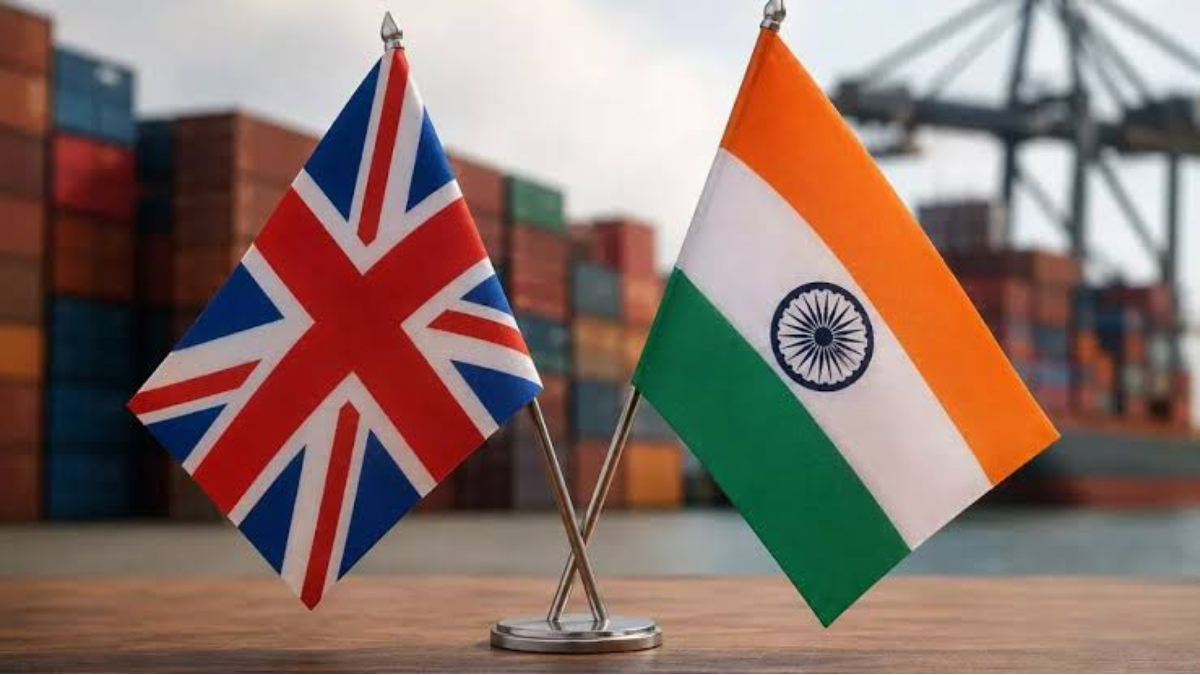



India has urged the United States to address trade concerns through bilateral negotiations instead of unilateral action, calling on the Office of the US Trade Representative (USTR) to reconsider its proposed 12.5 per cent tariff. New Delhi argued that the findings of the USTR's Section 301 investigation into forced labour contain inconsistencies and do not justify the proposed measure.
Presenting India's position during the public hearing, Joint Secretary in the Department of Commerce Brij Mohan Mishra said the country had engaged sincerely on issues related to forced labour and therefore strongly objected to the USTR's determination. He maintained that India treats the elimination of forced labour as both a constitutional responsibility and an obligation under international law and principles.
"India would like to highlight its concerns with the USTR's report and findings against India," Mishra said. He argued that the USTR had failed to meet the legal standards required under Section 301(d) of the Trade Act, adding that the absence of a prohibition on imports made with forced labour, without evidence satisfying other statutory requirements, cannot by itself be considered unreasonable under Section 301.
According to the written transcript of the July 8 hearing, later published on the USTR website, India also questioned the rationale behind imposing countrywide tariffs. It argued that the determination improperly groups 46 economies, including India, into a single category. The Section 301 investigation examines the failure of these economies to prohibit and effectively enforce restrictions on the import of goods produced with forced labour.
India further contended that the methodology adopted in the investigation is fundamentally flawed because it relies on case studies involving only a limited number of economies while drawing conclusions from broad trade patterns. Mishra said the report assumes that imports flagged as potentially involving forced labour are subsequently exported to the United States without offering sector-specific or country-specific evidence or demonstrating an actual connection to forced labour.
He also argued that, in India's case, the report fails to establish sufficient evidence that the absence of a forced labour import ban has created an unfair competitive advantage at the expense of American industry.
"In conclusion, it is submitted that the USTR reconsider the imposition of tariff in light of the identified inconsistencies in the report in the Federal Register notice. We ask any trade problems be addressed within the framework of the India-US bilateral trade negotiation, not through unilateral measures such as this investigation," he added.
India, Mishra said, remains prepared to continue engaging constructively with the USTR through consultations and dialogue on any specific concerns.
Representing the Agricultural and Processed Food Products Export Development Authority (APEDA), Shreyans Gupta, First Secretary at the Embassy of India in Washington, DC, challenged the USTR's observations regarding rice imports allegedly produced with forced labour and their purported impact on competition in the US rice market.
Gupta noted that India's rice imports are minimal and are intended to meet demand for specific niche varieties. He said the value of rice imported into India amounts to less than three per cent of the value of rice exported from India to the United States. He also pointed to regulatory safeguards that prevent imported rice produced with forced labour from being exported from India.
He added that rice exports from India to the US are permitted only from rice mills and processing units registered with the agriculture ministry. "For these reasons, the present investigation against India may be rescinded without prejudice," Gupta said, while requesting that Indian rice be exempted from the proposed duty if the proceedings continue.
Industry body Ficci also argued that the proposed additional tariff should be reconsidered. It said the measure would raise costs not only for Indian exporters but also for US manufacturers, importers, retailers and consumers. The chamber added that businesses already complying with existing standards would face higher costs as a result of the tariff.
Ficci urged the USTR to reassess the proposal in view of India's legal and regulatory framework, the compliance mechanisms adopted by Indian industry, and the potential impact on legitimate trade and resilient India-US supply chains.
The Confederation of Indian Industry (CII) echoed similar concerns, stating that the proposed 12.5 per cent tariff is unsupported by the evidence presented and is unlikely to achieve its stated objective. According to the chamber, the USTR report does not demonstrate that India's policy framework places an undue burden on US commerce.
The USTR initiated two separate Section 301 investigations on March 11 and 12, 2026, covering 60 economies over concerns related to forced labour and excess industrial capacity. On June 3, it released its findings on the forced labour investigation and proposed additional tariffs on imports from the economies covered by the probe.
Under the proposal, imports from Canada, Ecuador, the European Union, Indonesia, Mexico and Pakistan would face a 10 per cent tariff, while imports from 54 other economies, including India and China, would be subject to a proposed 12.5 per cent tariff. The proposal has not yet been finalised, and the USTR will review the comments and testimony submitted during the consultation process before making a final decision.
Also Read | India Climbs Two Spots in Global FDI Inflow Rankings