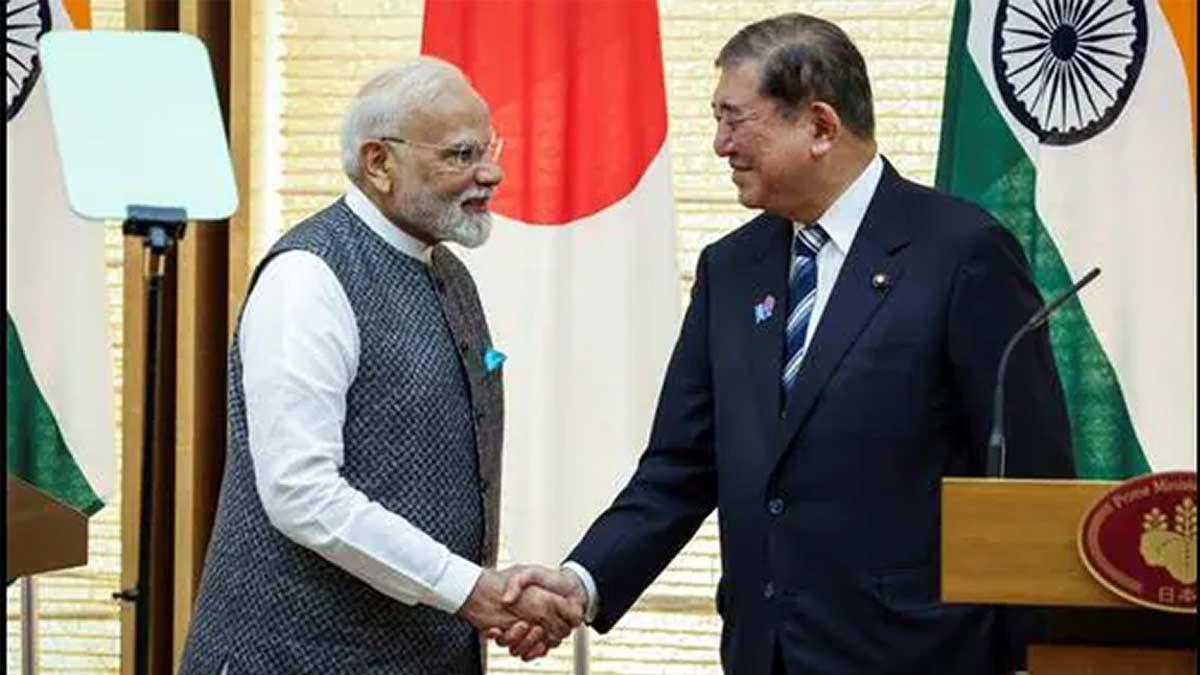


With China's increased assertiveness in the background, India and Japan on Friday unveiled a major upgrade of their security alliance, with the objective of augmenting each other's defence readiness, improving coordination on risk analysis, strengthening special forces cooperation, and carrying out joint exercises in the Indo-Pacific region.
The Joint Declaration on Security Cooperation, released after talks in Tokyo between Prime Minister Narendra Modi and his Japanese counterpart Shigeru Ishiba, sets out a new framework to boost defence and security ties — an area of steady growth over the past two decades. During this period, both nations have also expanded their security cooperation within the Quad grouping.
This new framework is an improvement over the previous declaration signed in 2008. It emphasized the "indispensable role" of Japan and India in securing an Indo-Pacific that is free, open, peaceful, and "coercion-free," which obligated the two parties to a closer partnership for their "national security and future economic dynamism." The agreement also promised greater coordination on common security issues in the Indo-Pacific and beyond while reaffirming backing for a rules-based global order.
A joint press statement apart, though not specifically naming China, mentioned that Modi and Ishiba shared "serious concern" regarding developments in the South China Sea and East China Sea. They rejected any "unilateral actions" that erode freedom of navigation and overflight or attempt to "change the status quo by force or coercion." The two leaders also expressed "serious concern over the militarisation of disputed features," China's construction of military installations in disputed parts of the South China Sea, and emphasized that maritime disputes should be resolved peacefully according to international law, especially the UN Convention on the Law of the Sea.
The Joint Declaration on Security Cooperation sets out a range of steps to enhance defence co-operation. These include high-level bilateral exercises, intelligence cooperation on new security threats, combined training in special operations forces, and more active utilization of the Bilateral Agreement on mutual provision of supplies and services to develop co-operation in logistics.
There are also plans to build a new dialogue system between the two nations' combined staffs, investigate tri-service exercises for humanitarian and disaster relief missions, and assist each other in specialized fields like counterterrorism and cyber defence. The two will also make greater use of their repair and maintenance facilities for the other nation's defence platforms.
Another key area of emphasis is defense against chemical, biological, and radiological threats. India and Japan will collaborate on detection systems, decontamination technology, and response strategies to protect their forces and people.
Maritime cooperation is highlighted in the declaration. Both countries will broaden naval and coast guard cooperation to ensure stability in the Indo-Pacific. Initiatives include greater situational awareness, coordinated action through the Information Fusion Centre – Indian Ocean Region (IFC-IOR), collective action against piracy and transnational crimes on the seas, and assisting third countries in maritime law enforcement.
On the defence technology and industry side, the cooperation will focus on developing resilience in areas critical to national security. These are including co-developing and co-producing defence equipment, relaxation of export control restrictions, as well as undertaking joint ventures in advanced technology fields.
The declaration also reaffirms commitments to combat terrorism, radical extremism, and organised crime through sharing of intelligence and experience. Cybersecurity cooperation shall be enhanced, with a focus on infrastructure resilience building, while space cooperation shall develop in satellite navigation, earth observation, and national security uses.
India-Japan defence relations suffered a setback in the wake of India's 1998 nuclear tests, which were severely criticized by Tokyo. Yet security ties have gained momentum since then on account of common fears of China's rising power and North Korea's nuclear ambitions, nurtured with the help of Pakistan.
Read also| Ahead of PM Modi's visit, Japan Cancels Its Trade Negotiator's US Trip