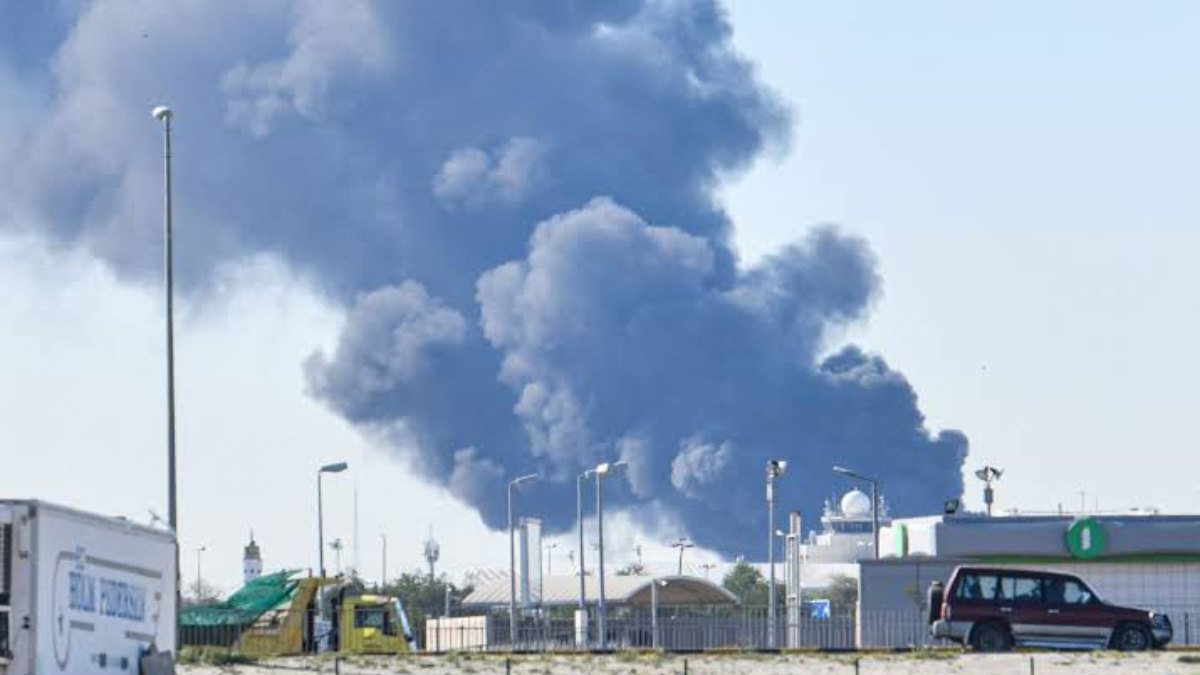


On Friday, Iran published a video claiming it had successfully targeted and blown up a strategic U.S. communications facility in Qatar during the recent military escalation between Tehran and Tel Aviv.
The Iranian Embassy in India posted the clip on social media platform X with a caption: "Satellite images show that #Iran has taken out the US military's primary Communications Radome in Qatar. The second Radome is in Kuwait."
The accusation has picked up steam after an investigation report published by Iran International, based on private satellite images that reportedly show damage incurred at the Al Udeid Air Base in Qatar—a major hub for American military presence in the Middle East.
Iran fired off a missile barrage on June 23, but satellite images obtained by a commercial provider on June 24 indicate apparent damage to a radome at the center of the base, the outlet reports.
This specific radome, a dome-like structure which normally covers sensitive satellite communications systems, in the photographs is a "blackened smear," without any comparable visible damage elsewhere on the extensive base. While the U.S. military has not yet officially commented on Iran International's questions, the imagery offers some of the most convincing visual proof of actual damage thus far.
Iran's June 23 missile attack came after U.S. strikes against three Iranian nuclear facilities the previous day, amid a fierce 12-day war that also engaged Israel. U.S. President Donald Trump subsequently announced the American campaign had "obliterated" Iran's nuclear facilities.
In response to Iran's missile counterattack, Trump minimized the intensity of the counterattack. "13 were shot down, and 1 was 'released,' because it was going in a non-threatening direction," he wrote on Truth Social. "I am happy to say that NO Americans were injured, and scarcely any damage was done.
CENTCOM confirmed the incident in a press release posted the same day, which read: "US forces, in partnership with our Qatari allies, successfully repelled an Iranian ballistic missile attack on Qatar's Al-Udeid Air Base outside Doha, Qatar."
The radome that may have been impacted is said to contain a Modernization Enterprise Terminal (MET), an advanced $15 million communications system first deployed at Al Udeid in 2016. As described in a release previously issued by the U.S. Air Force statement quoted by Iran International, the MET offers encrypted voice, video, and data connectivity to American forces across the CENTCOM area of responsibility and is fitted with advanced anti-jam capabilities. The system is deemed essential in ensuring direct communication between ground-based military units and U.S. leadership around the world.
Security analyst Farzin Nadimi, in an interview with Iran International, pointed out that the airbase is protected by a couple of U.S. Army-run Patriot missile systems and Qatari-owned defense batteries. "After they detected the Iranian missiles, they had barely two minutes to act," he explained.
Nadimi also suggested that perhaps a drone was involved in the attack. "It might have slipped through when the Patriot batteries were occupied dealing with incoming missiles," he said.
Although there had been a potential violation of critical infrastructure, the U.S. did not react militarily. President Trump instead asserted a ceasefire soon after the event, one that still stands. While Washington largely wrote off the Iranian missile launch as insignificant, the satellite images Iran International have accessed put renewed discussion about the true extent of damage wrought on U.S. assets in the Gulf back into the headlines.
Read also| Trump Announces 35% Tariff on Canadian Imports Effective August 1
Read also| Netanyahu Open to Permanent Gaza Ceasefire Talks if Hamas Agrees to Disarm