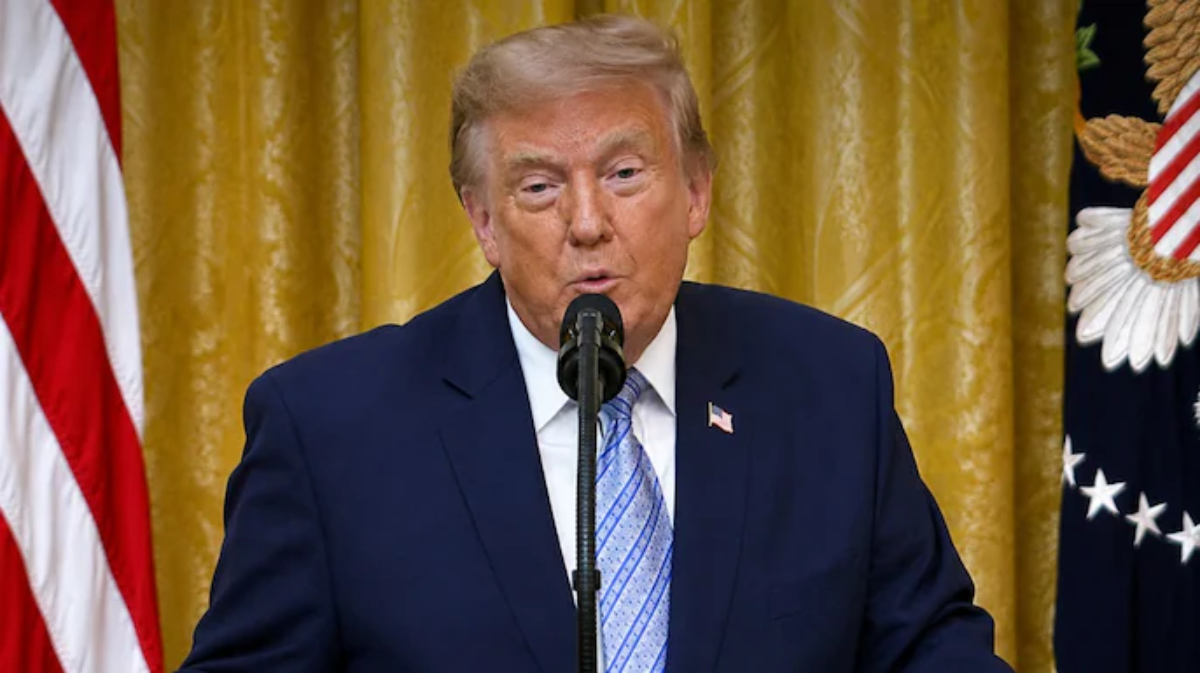


Well-known economist and Columbia University professor Jeffrey Sachs on Saturday told ANI that concerning US President Donald Trump’s tariffs which could be causing the United States more injury than benefit.
Sachs thought the tariffs were a pressure tactic on New Delhi and that they were very detrimental to at least a decade or more of gradual improvement in US-India relations in a speaking engagement with ANI
Sachs called Trump’s tariffs “bizarre” and “very self-destructive of US foreign policy interests” in his interview with ANI.
“It's a shocking level of incompetence. I see incompetence in the US government, I'm never surprised, but I'd say that this reached this level that I have to admit actually surprised me," he remarked, in response to Trump’s move to impose 25% secondary tariffs on Indian goods.
"Putting on the surcharge on India, was stupid as could be from any norm. It serves no purpose."
Trump originally announced the 25% tariffs in July, while hopes for a trade deal between India and the US seemed alive. Days later, he raised them to 50%, due to India's continued Russian oil imports.
Sachs warned that the tariffs could face serious legal hurdles. "...Tariffs are wrong in that they're destructive for the US economy.
It breaks all international laws. It's a collapse of our political system in the United States. We have a Constitution. We can't have one-person rule," he said, emphasizing the authority of US Congress under Article I, Section 8 of the Constitution.
"There's actually a lawsuit now in the US Appellate Court, which says that Trump has violated the law by imposing these tariffs. There's a real possibility that Trump's entire tariff regime will be deemed, as it should be, unconstitutional," he told ANI.
The economist also noted that Trump’s tariffs are “bound to fail,” both economically and geopolitically.
Sachs questioned the motivation of the Administration, asking whether Trump is really focused on Russian oil or if it’s doing something else.
He did not pull any punches in criticizing the US actions under President Trump.
“First, President Trump is being delusional. He thinks he can make demands and that others will accede to it,” he said. According to him, the US has exercised dominant power for so long that it now assumes it can “boss around every other part of the world.”
Turning to the Russia-Ukraine conflict, Sachs remarked, “Trump thinks he can dictate the terms of peace.” He went further, adding, “This war came about because the US attempted to ban Nato and overthrew a Ukrainian government in 2014 for that purpose of Nato expansion. It is a long term strategy, a reckless and failed one. It should end, but Trump is not politically smart enough or determined enough or brave enough to end this debacle. So he’s beating up, trying to beat up on India.”
He also underlined deeper geopolitical tensions. “There is a third part to it,” he noted, “The real animus of the US lies towards Russia, China, India and Brazil and South Africa.”
"They (tariffs) will not improve the US economy. They will isolate the United States geopolitically. They will strengthen the BRICS and other groups..." he said.
Highlighting Trump’s attitude towards BRICS, Sachs said, "Trump hates the BRICS. Why? Because they stand up and say to the US, you don't run the world. The world is multipolar and we want to cooperate with you, but we don't want you to run the world. President Lula summarized it best. He said, we don't want an emperor. This is basically the point. Trump thinks he's an emperor," he told ANI.
On India’s strategy, Sachs praised the government’s calm response.
"India's right. Take a deep breath. Don't do anything dramatic. Don't get too vituperative. I personally would do exactly what Prime Minister Modi's doing. He's flying to meet with President Xi Jinping. He's meeting with President Putin. He's meeting with President Lula."
He further added, "Those are India's real partners, by the way. Not only is the BRICS the fast-growing part of the world economy, but it's also the part of the world that says we don't want an emperor. We want multi-polarity and we want multilateralism."
India and the U.S. began negotiations on a Bilateral Trade Agreement (BTA) in March 2025, with each side hoping to complete the first stage by October–November 2025. Washington has been pressing for additional access to India's agriculture and dairy sectors, which are the livelihoods of millions.
At the same time, Trump was still pursuing a broader tariff strategy. On April 2, 2025, he signed an executive order on reciprocal tariffs that imposed 10 to 50% duties on various trading partners. Although initially the measures were held off for 90 days with a baseline 10% tariff, the deadline was later extended to August 1 and India experienced higher tariffs just before that deadline.
Responding to developments, commerce and industry minister Piyush Goyal told Parliament earlier this month that the government was closely assessing the impact of US tariffs. He said India “will take all necessary steps to safeguard the national interest.”
Read also| Peace Agreement and not ceasefire is best way to end 'horrific' Russia-Ukraine war: Trump
Read also| Watch| Viral Image Shows US Troops Kneeling to Roll Out Red Carpet for Putin