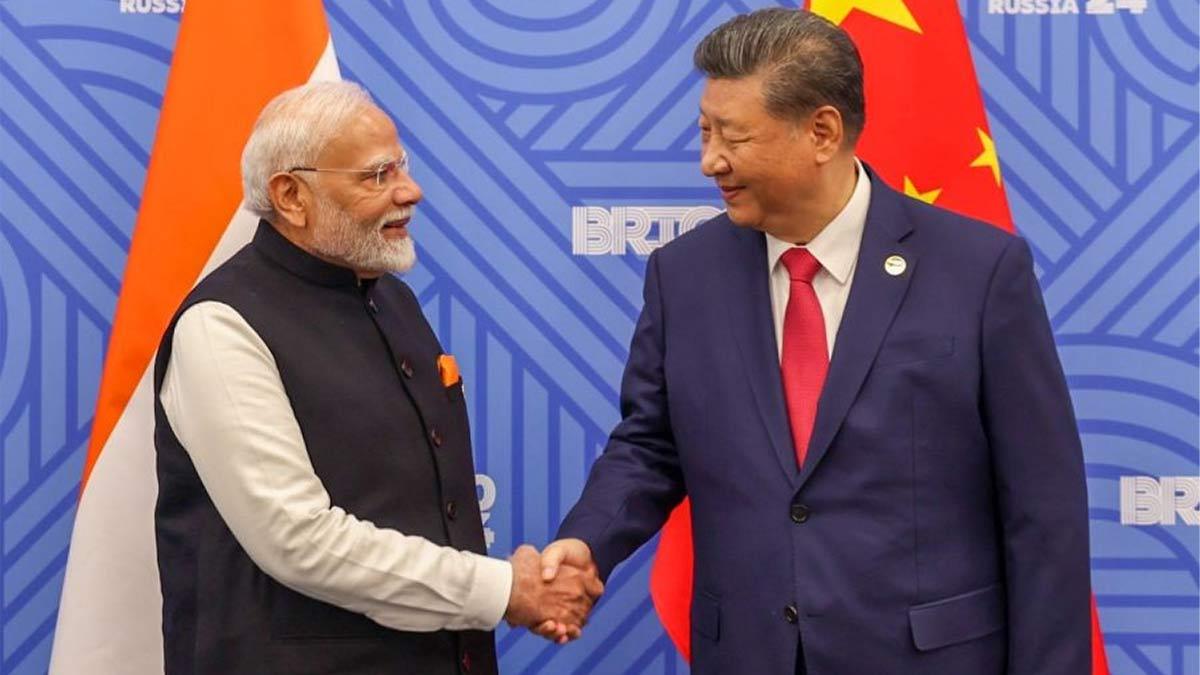


US President Donald Trump's tariff war triggered a significant development : India and China, the second- and fifth-largest economies in the world, are coming together, with a focus on trade cooperation. The move comes at a time when the two neighbors' bilateral relationship has recently been strained.
It is reported that even prior to Trump releasing his 'Liberation Day' tariffs in April, China had already turned to India to consider economic cooperation. In March, when Trump ramped up trade tensions with Beijing, China subtly began diplomatic overtures to India, according to a report by Bloomberg.
Chinese President Xi Jinping wrote a letter to President Droupadi Murmu to see if there are chances for bilateral interaction. An Indian official who had knowledge of the situation, told Bloomberg that the letter expressed Beijing's skepticism regarding possible US deals that would impact Chinese interests and appointed a regional official to head China's diplomatic mission. The letter was later passed on to Prime Minister Narendra Modi, according to the report. Following Xi's letter to Murmu, Beijing released a statement from the Chinese leader praising bilateral relations. After that,
Senior leaders, such as Vice President Han Zheng, echoed the sentiments, citing the warming relationship between the two nations.
National Security Adviser Ajit Doval, who has regular and direct interaction with China's senior leadership, is leading these diplomatic initiatives. As India's special representative for border negotiations, Doval visited China formally in December 2024 and then in June 2025.
As of June, the Indian government reportedly started actively seeking closer relations with China, coinciding with increasingly challenging trade negotiations with the US. New Delhi officials were said to be annoyed by Trump's comments that he could act as a mediator between India and Pakistan after their May clash.
In July, India's External Affairs Minister S. Jaishankar sat down with Wang Yi for the first time in five years in Beijing. Jaishankar brought up issues of "restrictive trade measures and roadblocks" in a veiled reference to Beijing's recent restrictions on rare earth exports that had shaken supply chains. New Delhi officials have confirmed that China had made guarantees about fertilizer and rare earth materials supply during these talks.
A number of positive developments have since strengthened bilateral relationships. Both countries intend to revive direct flight operations as early as next month. China relaxed the restrictions on exports of urea to India, and the Modi government reopened tourist visa services for Chinese nationals after a long hiatus.
On the corporate side, Gautam Adani-led Adani Group is said to be in talks with Chinese electric car maker BYD Co. to manufacture batteries locally and ramp up renewable energy initiatives, Bloomberg said. Reliance Industries Ltd. and JSW Group have quietly been seeking co-operation with Chinese companies in the backdrop of enhanced diplomatic ties.
By August, signs of progress in India-China relations were evident. Both countries, impacted by Trump’s tariffs, have made efforts to move past the 2020 border conflict, recommitting to resolve longstanding territorial disputes dating back to colonial times. Modi’s upcoming visit to China, his first in seven years, underscores this diplomatic momentum.
The United States’ long-standing strategic relationship with India, cultivated over multiple administrations to counter China’s influence, now faces challenges. This shift became pronounced when Trump imposed 50% tariffs on Indian exports due to New Delhi’s Russian oil purchases, creating significant pressure for Modi’s government.
"Trump is really the great peacemaker — he should take all the accolades for spurring the nascent rapprochement between Delhi and Beijing," Ashley Tellis, a senior fellow at the Carnegie Endowment for International Peace and a former US diplomat in New Delhi, said tongue-in-cheek. "He has done it singlehandedly by treating India as an adversary," Tellis told Bloomberg.
Modi and Xi will meet on September 1 on the sidelines of the Shanghai Cooperation Organisation summit in Tianjin, just outside Beijing.
The economic benefits to consolidating bilateral relations are obvious. China is experiencing slowing and deflation while dealing with oversupply in the electric vehicle and solar panel sectors. India, with its 1.4 billion young population, is a precious market, especially as Beijing is subjected to mounting trade barriers in the US, Europe, and other regions.
Indian policymakers are also seeing the significance of Chinese investment in manufacturing to help Modi raise the contribution of the sector to GDP to 25%. Bloomberg Economics calculates that if tariffs from the US stay high, as much as 60% of Indian exports to the US may be affected, reducing GDP by as much as 1% over the medium term.
Regulatory obstacles have also been limiting India's growth aspirations. According to Bloomberg News, the majority of Chinese employees at Foxconn Technology Group's iPhone plants in southern India were requested to vacate, and Chinese authorities have instructed regional and national agencies to restrict technology transfers and equipment shipments to India.
"The economic opportunities are enormous if the two nations are able to overcome differences and develop trust," said Antara Ghosal Singh, fellow at Observer Research Foundation, a New Delhi-based think tank.
"Both leaders have spoken frequently about economic opportunities but have not been able to overcome trust deficits," she added. "Trump is a good push for both nations to rethink their choices," she said in an interview with Bloomberg.
Read also| 'Hurting Americans': US Democrats Panel Criticizes Trump Over India Tariffs