
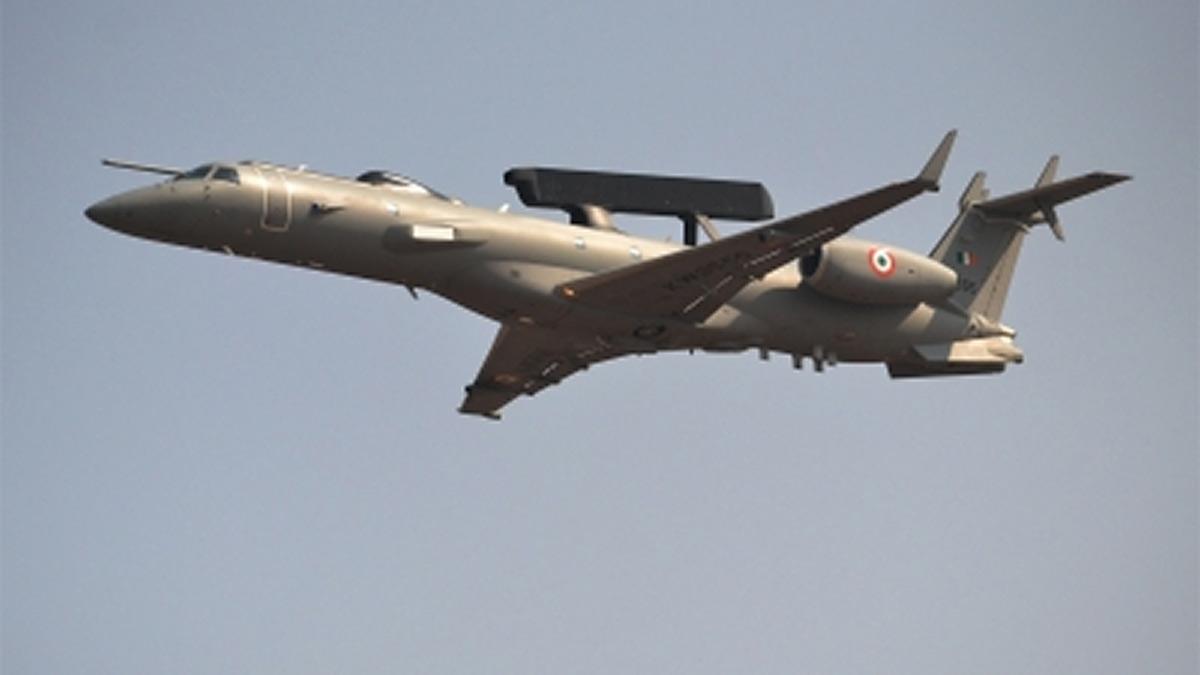


India's quest for defence indigenization and technological advancement has gone a great leap forward with the go-ahead for a $2.3 billion (Rs 20,000 crore) project to design next-generation Airborne Warning and Control Systems (AWACS) for the Indian Air Force (IAF), says a report on Friday.
The decision reflects India's commitment towards advancing surveillance, reconnaissance, and situational awareness, and in exerting strategic vision in addressing evolving security challenges in a complex geopolitical scenario.
"AWACS platforms are force multipliers which are essential in giving real-time intelligence, surveillance, and command and control functions from the air. These systems identify, track, and engage threats at extended ranges, providing the IAF with a unique operational advantage in airspace management," the Vietnam Times report explained.
The next generation of AWACS will integrate advanced radar technology, sensor fusion, and AI-based analytics. It will enable the Indian Air Force to track massive swaths of airspace with increased accuracy and responsiveness," it further added.
The report added that such sophisticated detection capabilities would provide earlier alerts and make coordinated action against aerial or missile threats possible. One of the key features of this $2.3 billion scheme is its focus on indigenous research, development, and manufacture aimed at enhancing India's indigenous defence technology base. As part of the Government of India's 'Make in India' and 'Atmanirbhar Bharat' programmes, the programme aims to decrease reliance on foreign vendors while enhancing the country's local defence industry ecosystem.
Next-generation AWACS platforms will boost the IAF's operational capability greatly, the report added. Equipped with advanced early warning and command capabilities, the Air Force will be more effective in air defence, offensive operations, and maritime surveillance.
The systems are also meant to integrate effortlessly into other Indian Armed Forces branches, including the Army and Navy, towards an organized and integrated national defence approach.
Investing in next-generation surveillance systems, the report highlighted, enhances India's deterrence value while reasserting its commitment to regional peace and stability.
The enhanced AWACS platforms will play a crucial role in tracking cross-border movements and deterring incursions, facilitating a safe environment that is conducive to economic growth and development.
By augmenting aerial command and surveillance capabilities, the project not only reinforces India's defense position but also fosters technological development, strategic independence, and economic growth.
It is a reflection of India's unflinching commitment towards securing its skies and establishing itself as an indomitable and technologically sophisticated nation on the global map. With this firm step, India inches closer to making its vision of a robust, self-sufficient defence ecosystem a reality that protects the interests of the nation and makes positive contributions to regional and global peace," the report summed up.
Read also| India and China Set to Resume Direct Flights Next Month After 5-Year Hiatus