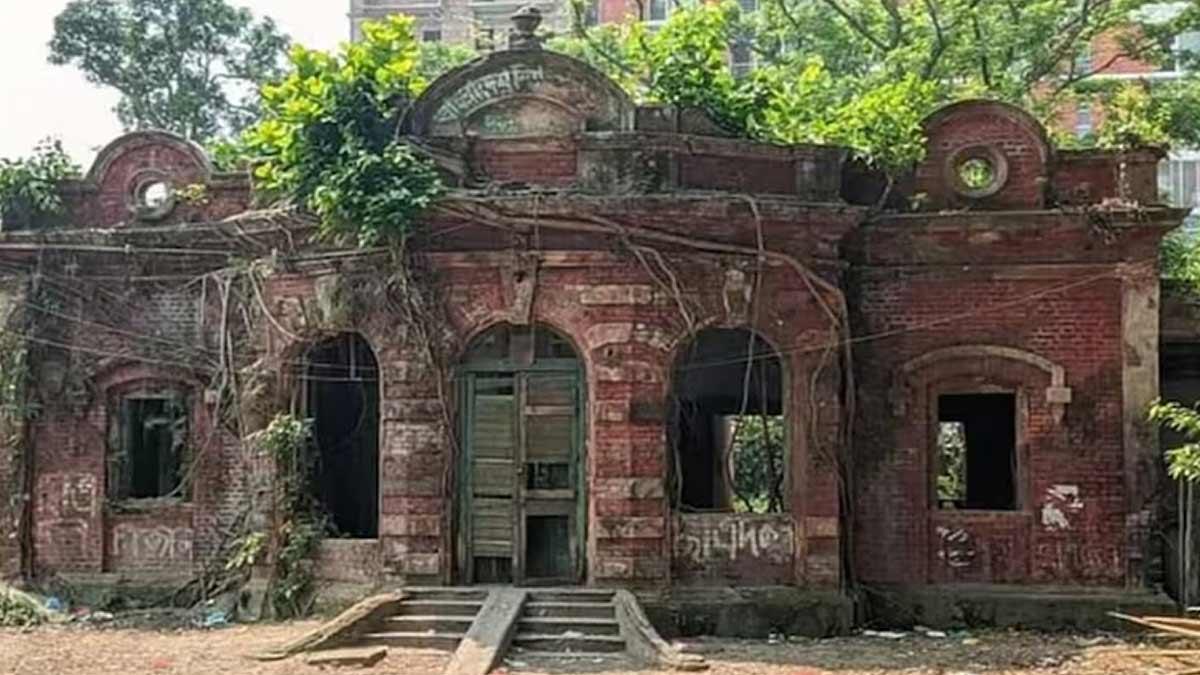


Bangladeshi authorities have suspended the demolition of the ancestral house of legendary director Satyajit Ray in the town of Mymensingh, amid a barrage of protest from India and cultural activists. A government committee has now been established to investigate options for the restoration of the old building.
The action followed India formally expressing outrage at the continuing demolition, with West Bengal Chief Minister Mamata Banerjee strongly objecting as well. She stressed that the house has great cultural importance to Bengal and must be saved.
The Mymensingh house had originally been owned by Upendrakishore Ray Chowdhury, Ray's grandfather and a renowned Bengali writer and thinker.
Clarifying the facts, Faisal Mahmud, Press Minister at the Bangladesh High Commission, explained to NDTV, "Ray never stayed in the Mymensingh house. His grandfather Upendrakishore most likely never stayed here too. He lived in Kotiadi in the Kishorganj district nearby. That house is already a heritage structure. This one in Mymensingh was owned by one of Upendrakishore's forebears. Its omission from the heritage list was an administrative error."
Bangladesh now has 531 listed protected heritage sites, but the Mymensingh house was not among them, giving the demolition work free rein to proceed.
This episode is another recent cultural flashpoint in Bangladesh—the desecration of Rabindranath Tagore's ancestral home in Shahzadpur, Sirajganj district. That incident involved an altercation over parking charges between a visitor and museum personnel. The altercation was escalated, leading to damage to property and assault on an official. The museum was temporarily closed, and there was an investigation.
In spite of all these incidents, Mahmud refuted the allegations that Bangladesh's cultural sites are at risk. "The episode regarding Rabindranath Tagore's building did not occur due to the fact that it was his building. A incident snowballed. In this instance, there was an administrative error, but immediately it became an issue due to the media, the government convened a meeting, chose to stop the demolition, and revive the building. Satyajit Ray is not the property of Bangladesh or India. He is the property of the entire world. He is the pride of all Bangladeshis. It was a miscommunication and it will be revived," he added.
India's Ministry of External Affairs (MEA) also conveyed grave concern in an official statement:
"We observe with deep regret that the ancestral home of celebrated director and litterateur Satyajit Ray at Mymensingh, Bangladesh, of his grandfather and renowned litterateur, Upendra Kishor Ray Chowdhury, is being razed to the ground.".
The building, which is currently owned by the Government of Bangladesh, is in a dilapidated condition. Since the building is an architectural landmark, representing Bangla cultural renaissance, it would be better to withdraw the proposal for demolition and consider options for repair and reconstruction of the building as a museum of literature and as a representation of the common culture of India and Bangladesh," the statement added.
"The Government of India would be happy to provide cooperation for the same."
Seconding this, West Bengal Chief Minister Mamata Banerjee remarked in a post on X (formerly Twitter):
"The Ray family is one of the leading custodians and bearers of Bengali culture. Upendrakishore is a giant of Bengal's renaissance. Thus, I feel this house has a deep connection with the cultural heritage of Bengal. I appeal to the government of Bangladesh and all the people of that nation with conscience to make efforts to preserve this heritage-rich house. The government of India must take cognizance of this issue."
These events are taking place amid tense diplomatic relations between India and Bangladesh. Relations became worse after the collapse of the Awami League government and the exodus of the then-Prime Minister Sheikh Hasina into India. A caretaker government, led by Nobel laureate Muhammad Yunus, took over in Dhaka afterwards.
Since the political change, India has complained about attacks on Hindu minorities in Bangladesh. Conversely, the new Bangladeshi authorities have accused India of interference in its internal affairs and insisted on Sheikh Hasina's return. These tensions were a dramatic break from the close bilateral relationships that had lasted for decades, especially since India's key role in Bangladesh's 1971 liberation.
Read also| Trump Hints at Major Trade Access to India in Potential Deal
Read also| 'Army chief Asim Munir responsible if anything happens to me', says Imran Khan