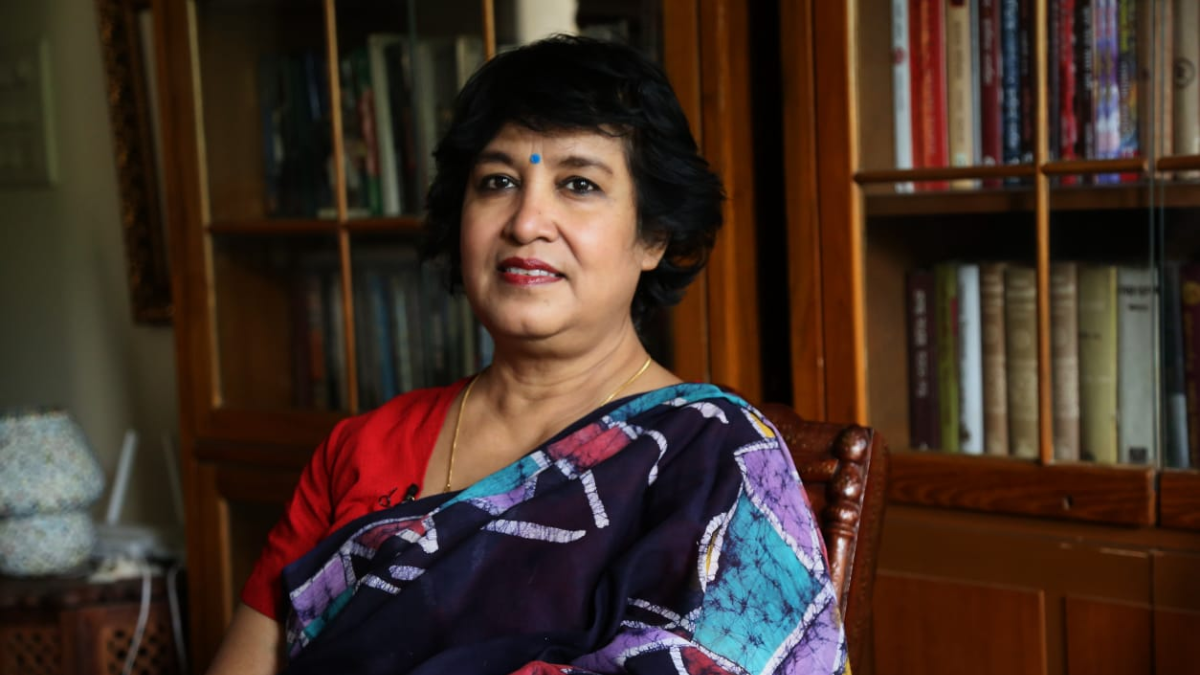


Exiled Bangladeshi author Taslima Nasrin will return to Kolkata next month for the first time in nearly 19 years to attend an anti-fundamentalism literary programme, a visit that has already taken on political overtones.
Though organisers have described the event as a tribute to secularism and freedom of expression, the BJP has portrayed Nasrin's visit as evidence of what it calls a “new Bengal" following years of political accommodation over religious sensitivities.
Nasrin announced through social media that she will arrive in Kolkata on August 1 to participate in an anti-fundamentalism programme at Rabindra Sadan, where she is scheduled to recite poetry.
The event is being hosted by a coalition of secular and anti-fundamentalist organisations. It comes just months after the BJP formed the government in West Bengal, at a time when discussions around freedom of expression and religious fundamentalism have regained prominence.
“It will basically be an event to celebrate her coming to the city after 20 years. She was forced to leave Kolkata on November 21, 2007, after the then Left Front government bowed before fundamentalist forces. This is a new Bengal, and we have decided to honour her. Chief Minister Suvendu Adhikari himself will be present at the event," organiser Mohit Roy of Paschimbangar Jonno told PTI.
Roy said, however, that organisers had not discussed whether the visit could eventually lead to Nasrin returning to Kolkata on a permanent basis.
For the BJP, the significance of Nasrin's arrival extends beyond a literary occasion.
According to a senior state BJP leader, successive Left Front and Trinamool Congress administrations had “chosen political expediency over free speech" by failing to facilitate her return despite repeated requests to attend literary festivals and book fairs.
The matter also reached Parliament last year, when BJP Rajya Sabha MP and current West Bengal BJP president Samik Bhattacharya appealed to the Centre to help facilitate Nasrin's return, calling her one of the few writers who has consistently spoken out against Islamist fundamentalism in Bangladesh.
Responding at the time, Nasrin said she no longer wanted to become the subject of shifting political agendas.
“I don’t want to get kicked around anymore. Instead, it would please me if the governments allow me to travel to Kolkata to attend literature festivals and book fairs," she had told PTI.
Nasrin first gained international recognition in the early 1990s through her feminist writings and outspoken criticism of religious orthodoxy. She left Bangladesh in 1994 after multiple fatwas were issued against her following the publication of her novel Lajja, which documented the persecution of Hindus in post-Babri Bangladesh.
After living in Europe and the United States for several years, she relocated to India in 2004 and made Kolkata her home, describing the Bengali-speaking city as the closest cultural refuge she had found during exile.
Her stay in the city came to an abrupt end in November 2007 after passages from her autobiographical work Dwikhandita sparked protests by sections of Muslim organisations. The demonstrations later turned violent, leading to Army deployment in parts of Kolkata.
The Left Front government headed by Buddhadeb Bhattacharjee subsequently asked Nasrin to leave the city. She was first moved to Jaipur and later to Delhi, where she initially remained under house arrest before the Centre granted her a long-term resident permit and a multiple-entry visa.
Her departure has since remained one of the defining episodes in West Bengal's debate over freedom of expression.
While critics accused the Left Front government of capitulating to pressure from protesters, the administration argued that preserving law and order had become its foremost priority amid escalating communal tensions. The Trinamool Congress governments that succeeded it largely refrained from revisiting the issue despite repeated appeals from writers and members of civil society.
Organisers say the August 1 programme has been planned to honour Nasrin's longstanding opposition to religious fundamentalism and to reaffirm the importance of free expression.
Whether the occasion remains a literary celebration or develops into a wider political statement may ultimately depend as much on the symbolism surrounding Nasrin's return as on the poetry she is expected to recite.