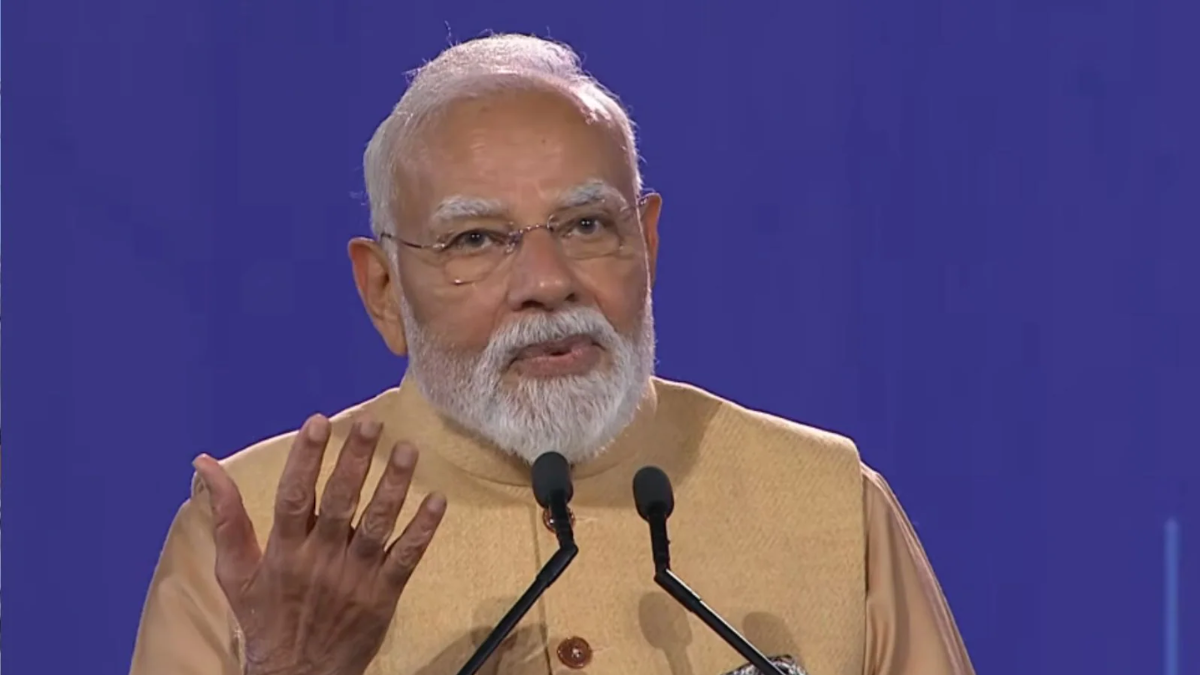


Prime Minister Narendra Modi on Friday said the rapid electrification of Indian Railways over the past 12 years has significantly reduced the country's dependence on imported fuel, asserting that the rail network would have come to a "complete standstill" during the ongoing crisis in West Asia had a similar situation arisen before 2014.
Speaking after flagging off India's first hydrogen-powered train at Jind railway station in Haryana, the Prime Minister said the conflict around the Strait of Hormuz has highlighted the importance of the government's push towards railway electrification.
"The massive changes that have taken place in the Indian Railways in the last 12 years have benefited India in another way. You are seeing that for the last several months, there has been a war going on in West Asia, in the entire Hormuz region, Iran, and the Gulf. The sea route through which India receives a large amount of petrol, diesel, LPG, and fertiliser for our farmers passes through that very region. But for the last 3-4 months, this route has become a constant battlefield and is surrounded by crises," PM Modi said.
Recalling the railway network's earlier dependence on diesel-powered locomotives, he argued that India would have faced a severe transport crisis if fuel supplies had been disrupted before 2014.
"If this situation had come before 2014, then India's railways would have come to a complete standstill because, at that time, a very large part of the country's trains ran only on diesel.Now think, if the diesel supply had stopped, how would those diesel trains have run? The country would have been in such a big crisis. But friends, this is not the situation of 2014. This is Modi. He thinks way in advance and also brings solutions to problems on the ground," he added.
The Prime Minister said the pace of railway electrification had accelerated dramatically over the last decade.
"The electrification of Indian Railways began in 1925, nearly 100 years ago. From 1925 to 2014, in about 90 years, less than one-third of the rail network-around 30%-was electrified, while the remaining 70% ran on diesel," Modi said.
"At that pace, it would have taken another 200 years to fully electrify the network. But in the last 12 years, nearly 99% of India's rail network has been electrified. In Haryana, the rail network has been electrified 100%," he added.
Drawing a parallel between different eras of railway technology, Modi said the 19th century was dominated by steam locomotives, the 20th century by diesel and electric trains, while the 21st century would belong to hydrogen-powered rail transport.
Highlighting the transformation of the railway network, the Prime Minister said only about 30 per cent of India's rail infrastructure had been electrified between 1925 and 2014, whereas nearly 99 per cent has been electrified over the past 12 years.
He said the large-scale shift towards electrification has enabled Indian Railways to continue operating without disruption despite global conflicts and uncertainties affecting international oil supplies.