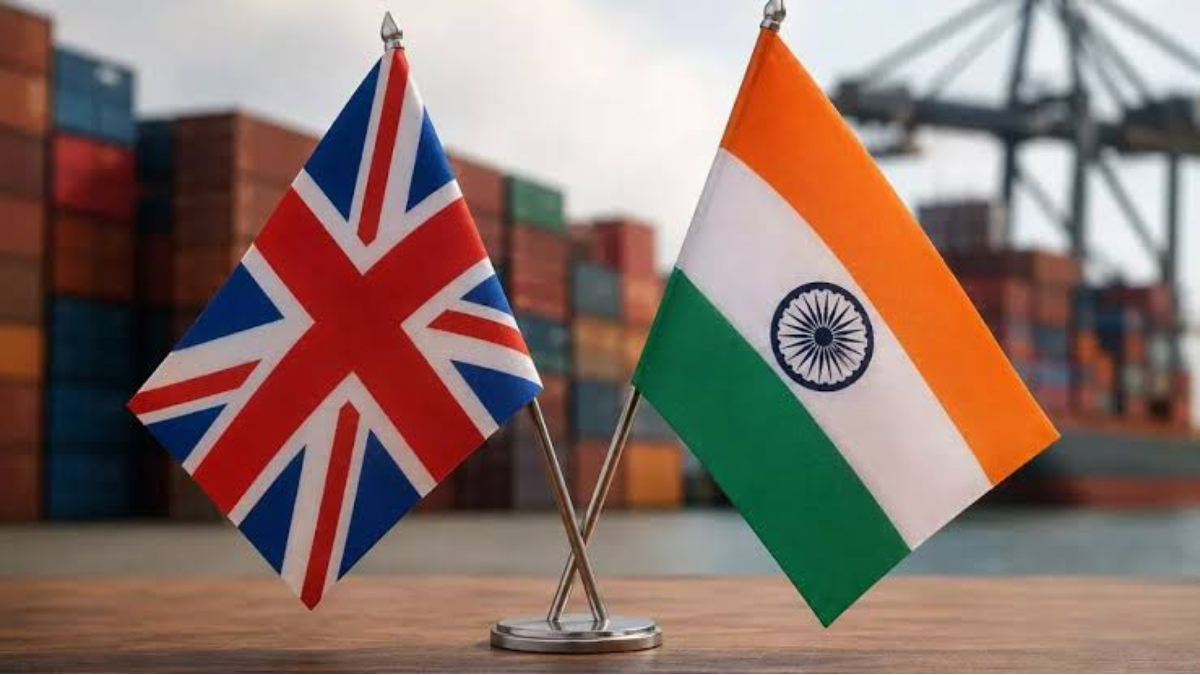


In a landmark moment for bilateral relations, India and the United Kingdom on Thursday finalized a comprehensive trade agreement designed to eliminate tariffs on a broad range of products, including automobiles, textiles, and whisky.
The deal was signed during Prime Minister Narendra Modi’s visit to the UK, where he met with British Prime Minister Keir Starmer at Chequers, the latter's official countryside retreat.
The Comprehensive Economic and Trade Agreement (CETA) was also inked by India's Commerce Minister Piyush Goyal and UK Business and Trade Secretary Jonathan Reynolds in front of the two prime ministers.
The agreement will boost two-way trade by about USD 34 billion every year and provide better access to one another's markets.
Characterized as Britain's biggest trade agreement since the country's withdrawal from the EU, CETA follows increased worldwide attention to protectionist practices in the wake of recent U.S. President Donald Trump's tariff moves.
Under the overarching framework, India and the UK have also committed to negotiating a Double Contribution Convention (DCC). Under this treaty, Indian employers will be exempted from making UK social security contributions on their employees for three years, and will come into force along with CETA.
After their top-level discussions, Modi and Starmer also announced a defence industrial roadmap for co-developing and co-producing advanced military technologies and platforms. As a simultaneous step to boost security cooperation, the Central Bureau of Investigation (CBI) and the National Crime Agency (NCA) of the UK signed an agreement of cooperation.
The Indian side also brought up issues regarding the activities of pro-Khalistani forces based out of British soil. Modi issued a sharp warning during the negotiations, saying that "forces with extremist ideologies cannot be allowed to exploit democratic freedoms."
The trade deal remains the centerpiece of Modi’s UK visit. It offers India comprehensive tariff relief on nearly 99% of product categories, accounting for almost all trade value, and promises wide-ranging market access for Indian exports.
"This agreement is more than just an economic partnership; it is also a blueprint for shared prosperity," said PM Modi in his official statement.
"It will increase access to UK markets for Indian goods such as textiles, footwear, gems and jewellery, seafood, and engineering goods. It also provides new opportunities for our agriculture and processed food industries. This agreement is especially empowering for our youth, MSMEs, farmers, and fishermen," he clarified.
Modi went on to say that British-made goods, including medical devices and aerospace parts, will be more affordable and accessible for Indian consumers and industries.
UK Prime Minister Keir Starmer shared the excitement, saying, "Our historic trade deal with India is a huge victory for Britain. It will generate thousands of British jobs across the whole of the UK, open up new opportunities for businesses and boost growth in all parts of the country." He also said that British shoppers would see the cost of Indian imports such as clothes, shoes, and food coming down.
The leaders also co-launched the "India-UK Vision 2035", a long-term roadmap of cooperation in key areas like defence, climate, technology, education, and migration.
"This roadmap will steer our trusted and ambitious partnership. From artificial intelligence to critical minerals, from semiconductors to cybersecurity—we are determined to create the future together," Modi underlined.
The Vision 2035 pact, as per the Ministry of External Affairs (MEA), will give a new lease of life to the Comprehensive Strategic Partnership, navigating the next decade of bilateral relations with an emphasis on innovation and sustainable development.
Both sides also discussed implementation of the Technology and Security Initiative (TSI) initiated a year back that focuses on cooperation in cutting-edge areas like telecom, artificial intelligence, quantum tech, semiconductors, biotech, and critical minerals.
Education was a second major area of concern, with both leaders embracing initiatives to enhance academic collaboration. Significantly, six UK universities are planning to establish campuses in India under the nation's New Education Policy (NEP).
In a social media update following the meeting, PM Modi characterized his exchange with Starmer as "outstanding", mainly commending the successful negotiation of the trade agreement.
"The negotiations with PM Keir Starmer were excellent, especially following the successful signing of the Comprehensive Economic and Trade Agreement. This agreement, besides economic collaboration, also paves the way for increasing mutual prosperity," Modi stated.
The issue of security concerns were also brought up in the meeting, specifically about pro-Khalistani extremism in the UK. India was very much opposed to the matter, most especially after the March 2023 attack on its High Commission in London.
"We concur that forces with extremist ideologies cannot be permitted to exploit democratic freedoms. Those who exploit democratic freedoms to assail democracy itself need to be held accountable," Modi said.
As India and the UK look to a new chapter in their diplomatic relations, the signing of CETA and the launch of Vision 2035 mark a commitment to furthering relationships not merely in trade but across the entire range of strategic, technological, and people-related fronts.