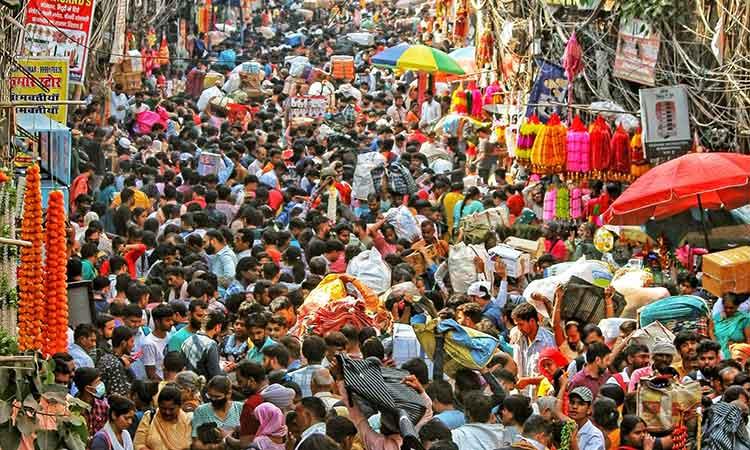


The world population is projected to reach 8 billion on November 15, with India overtaking China as the world's most populous nation in 2023, according to the UN's World Population Prospects 2022.
Currently, the global population is growing at its slowest rate since 1950, having fallen under 1 per cent in 2020.
The world's population could grow to around 8.5 billion in 2030 and 9.7 billion in 2050, as per the United Nations projection.
The population is predicted to peak at around 10.4 billion in the 2080s and to remain there until 2100.
"It is a reminder of our shared responsibility to care for our planet and a moment to reflect on where we still fall short of our commitments to one another," said UN Secretary General Antonio Guterres.
Also read | Guterres calls for greater equality as world population hitting 8 billion
A majority of the projected population growth up to 2050 will take place in eight countries: the Democratic Republic of the Congo, Egypt, Ethiopia, India, Nigeria, Pakistan, the Philippines, and Tanzania, according to the report.
"The relationship between population growth and sustainable development is complex and multidimensional," said Liu Zhenmin, UN Under-Secretary-General for Economic and Social Affairs.
"Rapid population growth makes eradicating poverty, combatting hunger and malnutrition, and increasing the coverage of health and education systems more difficult," he added.
Global life expectancy at birth reached 72.8 years in 2019, an improvement of almost 9 years since 1990, said the report.
By 2050, it is projected that global life expectancy will be 77.2 years. However, in 2021, the least-developed countries lagged behind the global average by 7 years.
Also read | Technology cannot remain confined to big players: India at COP 27
Moreover, experts claim that further temperature rises will lead to catastrophic effects on several nations, causing more action to reduce greenhouse gas emissions.
"Multiple factors contribute to climate change, and multiple actions are needed to address it. The number of people on our planet is one of those factors. Every additional person increases carbon emissions - the rich far more than the poor - and increases the number of climate change victims - the poor far more than the rich," reports PopulationMatters.
Due to climate change, glaciers and ice caps are receding, decreasing fresh water resources. This causes coral reefs and other aquatic ecosystems to die by accelerating ocean acidification.