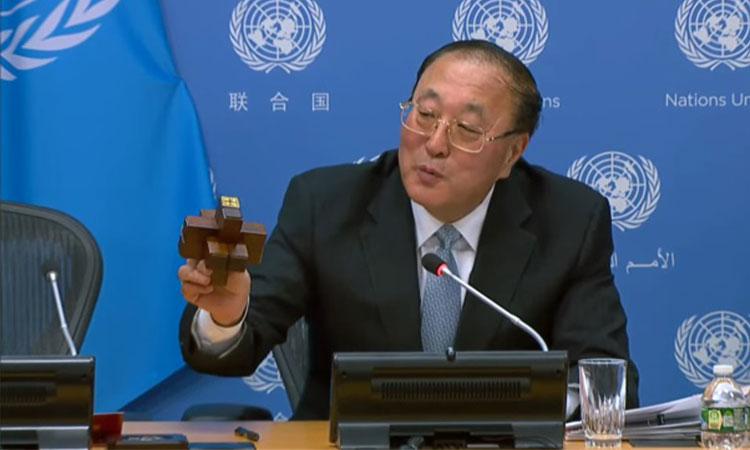


China, holding the presidency of the UN Security Council for the month, marked its leadership by presenting an ancient toy to the council members. Zhang Jun, China's Permanent Representative to the United Nations, offered this gesture using the traditional toy as a symbolic representation of the importance of unanimity and unity within the council. The move reflects China's unique approach to diplomatic gestures within the international community.
“Let’s take this as peace; once it’s broken, it can’t be fixed easily and one piece alone can’t do anything,” he said holding up the toy known as the 'Lu Ban Lock' with six interlocking pieces of wood that collapses if one is removed.
He might be referring to the veto authority wielded by the permanent members of the Security Council, China being one of them. China recently exercised its veto power to block a resolution proposing a humanitarian pause in the conflict between Israel and Hamas. Interestingly, he downplayed any connection to the veto powers.
The Security Council, the sole entity capable of enforcing its decisions, faced a deadlock in reaching a consensus on advocating for a humanitarian pause or a ceasefire in the Israel-Hamas strife. None of the four resolutions presented gained approval; two fell victim to veto powers—China and Russia casting theirs against one, while the U.S. opposed the other. The remaining two resolutions faltered due to an inability to secure the required majority of eight votes.
China and Russia rejected the resolution they vetoed, citing its failure to call for a ceasefire. On the other hand, the U.S. objected because the resolution didn't explicitly affirm Israel's right to self-defense.
Zhang underscored the moral and legal obligations of the Council in addressing the conflict and emphasized the collective belief among council members in the necessity of taking action. Despite acknowledging the complexities involved, he remained forthright about the challenges faced.
Finding solidarity and cooperation of the members “is not an easy job”, he said.
“I'm not in a position to tell you that I can get all the things done, but what I can tell you is that we will spare no effort in facilitating the cooperation of council members in fulfilling our tasks and our responsibilities,” he said.
This marks the current stance of the Council.
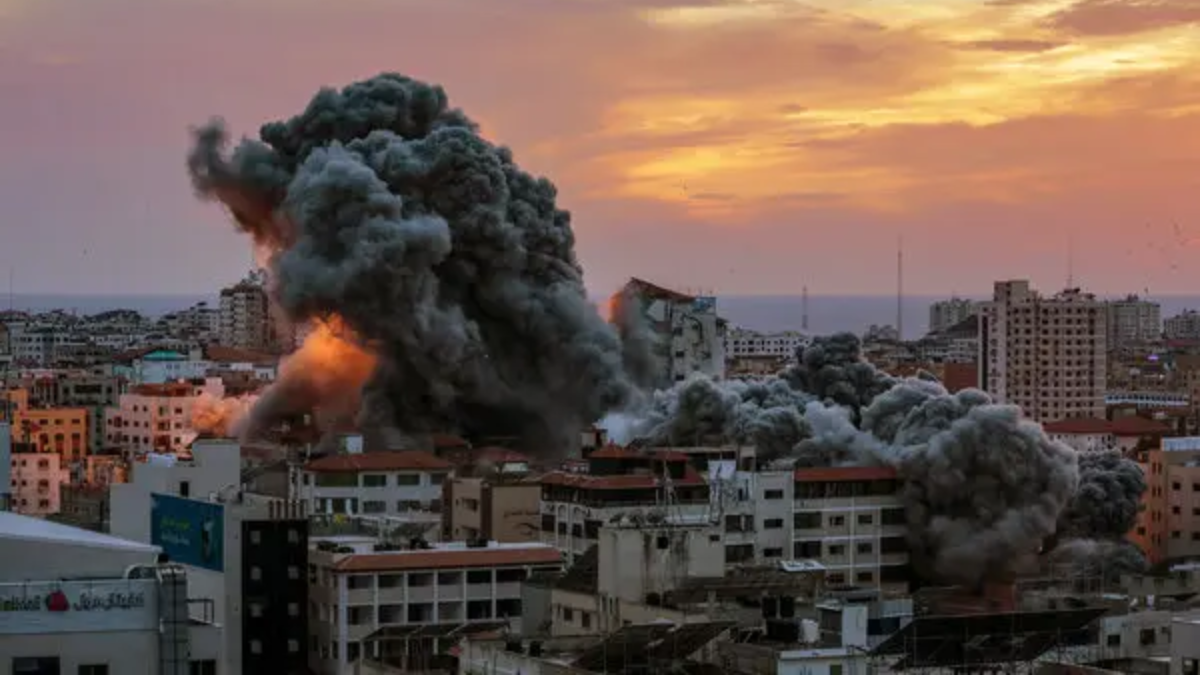
Over a month has passed since the ruthless October 7 assault on Israel by Hamas, resulting in 1,200 casualties and over 240 individuals being taken as hostages. In response, Israel launched brutal reprisals against Hamas in Gaza, claiming the lives of 10,000 people, as reported by the territory's health ministry under Hamas control.
The General Assembly passed a resolution advocating for a humanitarian truce, with 120 members supporting it among the 193 in the body, 14 opposing, and 45 abstentions, including India's. However, the resolution holds mainly symbolic significance.
In contrast, the UN has recorded tangible achievements in various areas. Stephane Dujarric, spokesperson for Secretary-General Antonio Guterres, dismisses the frequent assertion that the UN is a failure. He highlights successful actions in areas where the organization can make a meaningful impact.
“I think the question is which UN you are talking about, right? I can only speak for a part of that, and that's the Secretary-General's,” he told a reporter who spoke of the UN’s ineffectiveness.
“There are other parts, legislative parts in the UN that could be doing more to ensure an end to this conflict," he said in a criticism of the deadlocked Council.
The diplomatic efforts led by the UN, operating under Secretary-General Guterres rather than a mandate from the Council, played a pivotal role in facilitating the reopening of the Rafah border crossing connecting Egypt and Gaza. This opening allowed vehicles to transport essential relief supplies, including food, medicine, and water, providing a crucial lifeline to Palestinians in Gaza who were facing the imminent threat of starvation.
A significant portion of the aid originates from UN agencies, which also coordinate the logistics of transportation. Guterres personally visited the border to advocate for the alleviation of Israel's restrictions on relief access to the 2 million people trapped in Gaza.
Despite the UN's call for a minimum of 100 trucks to enter daily, Israel has granted permission for fewer vehicles. Nevertheless, this represents a diplomatic and organizational victory for the UN.
Tragically, the most poignant testament to the UN's effectiveness in Gaza is the loss of over 100 staff members in its relief operation since the events of October 7.
(With Agency Inputs)
ALSO READ | Gaza's Al-Shifa Hospital Hit by Failed Terrorist-launched Missile: IDF