

Iran concluded a week of nationwide mourning on Friday with the burial of former Supreme Leader Ayatollah Ali Khamenei at the Shrine of Imam Reza in Mashhad, according to state media. The interment at the country's holiest shrine followed days of funeral processions, religious observances and mass rallies held across Iran and Iraq. Throughout the burial ceremony, his son and successor, Mojtaba Khamenei, remained absent from public view, with continued attention focused on his undisclosed whereabouts.
The funeral ceremonies unfolded against a backdrop of renewed friction between Iran and the United States after several weeks of calm under a truce reached during the four-month-old conflict.
Khamenei was killed in the opening strikes of the war launched by the United States and Israel on February 28. The United States and Iran agreed to a truce last month.
On Thursday, thousands accompanied Khamenei's coffin through the crowded streets of Mashhad toward the Shrine of Imam Reza. Clerics wearing white turbans walked beside the vehicle transporting his body, while mourners dressed in black carried Iranian flags, displayed portraits of Khamenei and raised red placards featuring revolutionary slogans. Iran's clerical establishment urged supporters to turn out in large numbers, seeking to demonstrate the Islamic Republic's resilience and ideological unity. The ceremonies represented the final stage of a week of public mourning observed in both Iran and Iraq.
Although Iran endured months of conflict with the United States and Israel, it continues to grapple with serious domestic pressures. Khamenei's 37-year tenure also remains the subject of deep divisions within the country.
Mojtaba Khamenei, who a clerical assembly proclaimed supreme leader in early March, one week after his father's death, has not appeared in public since the war began.
Although he has issued written statements, authorities have not released any image, video or audio recording of him.
According to senior sources in Tehran, Mojtaba suffered severe injuries in the strike that killed his father, leaving him with facial disfigurement and serious limb injuries. The sources said he is recovering but has not regained sufficient health to make public appearances. State security services are also limiting his exposure over concerns about possible future US attacks.
ANTI-US SLOGANS DOMINATE FUNERAL
As mourners assembled in Mashhad for the procession, chants directed against US President Donald Trump rang out among the crowd.
"I swear by the blood of the supreme leader, Trump, we will kill you!" the crowd shouted, while some women held placards reading "Kill Trump."
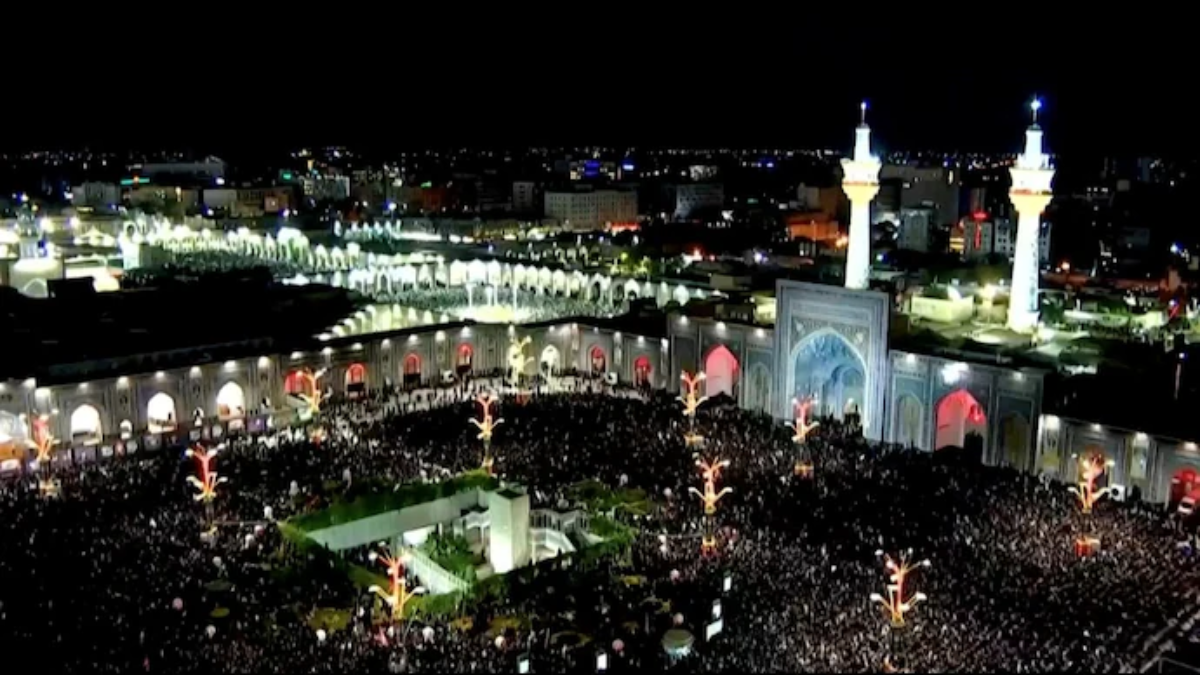
As darkness settled, the courtyard of the Shrine of Imam Reza filled with mourners. Loudspeakers broadcast funeral music and laments while chants of "Death to America" echoed across the shrine.
For the final stage of the procession, a helicopter carried Khamenei's coffin above the densely packed crowd before it was taken to a blue-tiled arched recess inside the shrine.
Khamenei's eldest son, Mostafa, led the funeral prayer before male mourners carried the coffin, draped in the colours of Iran's national flag, into the shrine. Many inside the complex held candles, reached toward the coffin and wept.
Early on Friday, the official IRNA news agency reported that Khamenei and four members of his family who were killed alongside him had been buried.
Located in Khamenei's hometown of Mashhad, the Shrine of Imam Reza is among the holiest sites in Shi'ite Islam and is one of the religion's most significant pilgrimage destinations.
Before the burial, Khamenei's remains were taken through Tehran, the clerical centre of Qom, and the Iraqi shrine cities of Najaf and Karbala. Large crowds gathered at each stop, chanting revolutionary slogans while taking part in Shi'ite mourning rituals.
Iranian authorities have portrayed Khamenei's death at the hands of foreign adversaries through the religious and political framework of martyrdom, a concept that occupies a central place in Shi'ite theology.
FUNERAL MARKS END OF NEARLY FOUR DECADES IN POWER
Khamenei's funeral takes place at a defining moment for Iran, closing nearly four decades of his leadership and coming only months after the latest wave of nationwide protests against the Islamic Republic.
Security forces suppressed those protests, which were driven by anger over the sanctions-hit economy, by killing thousands of demonstrators during a broad crackdown that echoed previous episodes of unrest.
Analysts believe Iran emerged from the war with the United States in a stronger strategic position while retaining control over the Strait of Hormuz. However, the country also suffered widespread damage that added to its economic challenges.
Khamenei became supreme leader in 1989, a decade after Iran's Islamic Revolution. Over the course of his rule, he concentrated political, military and economic authority in the office of the supreme leader while steadily reducing the influence of the elected president and parliament.
He strengthened that system in close coordination with the Islamic Revolutionary Guard Corps, whose influence expanded throughout his rule. Mojtaba Khamenei assumed the position of supreme leader with the backing of the Guards, which many observers now regard as the dominant force in Iran's political and strategic decision-making.
Also Read | 'US Jobs Are For Americans, Not Foreign Fraudsters': Vance speaks out amid H-1B probe
Also Read | Erdogan presents engraved revolvers and ammunition to NATO leaders after summit