
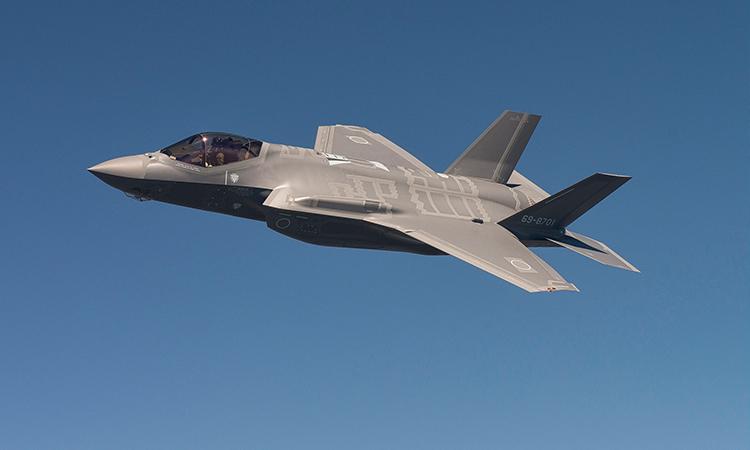


Lockheed Martin's F-35 fighter jets that are already being flown by the U.S. and eight allies, remains marred by 871 software and hardware deficiencies that could undercut readiness, missions or maintenance, according to the Pentagon’s testing office.
Lockheed has delivered or is under contract for 970 aircraft of a potential 3,200 or more planes for the US and other nations.
The assessment, accessed in advance by Bloomberg before its publication, outlines the seemingly intractable roster of flaws - it’s down only two from the 873 that Robert Behler, the director of operational testing reported last year - and provides the incoming Biden administration with a primer on the $398 billion F-35 program that retains strong backing in Congress and from overseas purchasers despite its problems.
Those include a stalled one-month simulation exercise required to certify the plane is combat-ready against the toughest Russian or Chinese threats and thus ready for a decision on full-rate production.
Laura Seal, a spokesperson for the Defense Department’s F-35 program office, declined to comment until Behler’s report is released officially.
The F-35 program also faces a $10 billion shortfall in the Pentagon’s planned budget for 2021 through 2025. The Trump administration’s final budget blueprint calls for requesting $78 billion for research and development, jet procurement, operations and maintenance and military construction. But the Pentagon’s independent cost analysis unit estimates $88 billion will be needed, according to a June 2020 analysis.
F-35 upgradation
The F-35 program is undergoing a “Block 4” upgrade costing at least $12.1 billion that’s intended to correct past deficiencies and introduce new capabilities in six-month increments through 2026 to keep up with current threats. The plan includes retrofitting some planes already built and in use by militaries from the US and the UK to Japan.
The Block 4 process “is not working,” Behler wrote. “It is causing significant delays to planned schedules and results in poor software quality, containing deficiencies.” Software changes “intended to introduce new capabilities or fix deficiencies often introduced stability problems.”
Only 10 of the 871 unresolved deficiencies cited by Behler involve potentially serious “Category 1” issues, defined as critical deficiencies that could jeopardize pilot or aircraft safety or degrade mission effectiveness. That’s compared with 102 such problems among the 941 cases cited in 2018.
Lockheed said in a statement that none of the 10 current deficiencies are “1A” problems that could affect pilot or aircraft safety but instead are in “Category 1B,” which the program office defines as representing “a critical impact on mission readiness,” training or maintenance.
A defense official who’s seen the Behler assessment said many of the deficiencies will be resolved with production line changes and software updates. Although deficiencies must be documented for contractual and reporting purposes, the official said, depending on their severity they might not be rapidly resolved. The size, scope and resolution status are being evaluated as part of the ongoing negotiations for a 15th production contract, the official said.
Among other findings, the testing office’s report said that although the F-35 is showing increased reliability, it’s still taking maintenance personnel too much time to repair aircraft and that cybersecurity vulnerabilities identified during earlier testing “have not been resolved.