

China has lodged a formal diplomatic protest with Japan after Tokyo joined 13 other countries in reaffirming a landmark international ruling that invalidated Beijing's sweeping claims in the South China Sea.
Beijing summoned the Japanese envoy on Sunday, accusing Tokyo of interfering in regional affairs and harming peace and stability. Chinese authorities also reiterated that the country's sovereignty over the disputed waters has "never changed" despite the 2016 arbitration ruling.
The diplomatic dispute followed a joint statement issued by Japan, the United States, Australia, the United Kingdom, the Philippines and nine other countries marking the 10th anniversary of the Permanent Court of Arbitration's decision. The statement reaffirmed that China's broad maritime claims have "no legal basis" under international law. The European Union separately backed the ruling, drawing further criticism from Beijing.
China's foreign ministry summoned the chief minister of the Japanese Embassy in Beijing to convey what it described as "solemn representations" while expressing "strong dissatisfaction and protest" over Japan's stance.
According to Chinese state news agency Xinhua, Beijing accused Tokyo of challenging China's territorial sovereignty in the South China Sea and undermining regional peace and stability.
Japanese Foreign Minister Toshimitsu Motegi had earlier said China's refusal to accept the 2016 arbitration ruling goes "against the principle of peaceful settlement of disputes" and "undermines the rule of law in the international community." China rejected the comments, arguing that Japan has no role in the dispute.
"On July 12, Japan's Foreign Minister Toshimitsu Motegi made a statement ten years after the "2016 Arbitral Award on the South China Sea." The statement blatantly endorses the illegal "award," attacks China's lawful claims and mischaracterizes Japan as a "legitimate stakeholder who uses the South China Sea." China strongly deplores and firmly opposes it," the Chinese foreign ministry said, according to the China government's mouthpeice Global Times.
Beijing also accused Japan of attempting to revive its wartime ambitions.
"Now decades later, Japan, in the name of a 'stakeholder,' is again attempting to meddle in the South China Sea. This reminds people of Japan's history of aggression and expansion, and heightens their vigilance against Japan's neo-militarism agenda," the spokesperson said.
The latest diplomatic exchange came after 14 countries jointly reaffirmed the July 12, 2016 ruling of the Permanent Court of Arbitration in The Hague, which found that China's "nine-dash line" claim covering most of the South China Sea has no legal basis under the UN Convention on the Law of the Sea (UNCLOS).
The United States, Australia, Canada, Estonia, Germany, Italy, Japan, Latvia, Lithuania, New Zealand, the Philippines, Romania, Slovenia and the United Kingdom described the ruling as "a significant milestone" that is "final, legally binding, and definitive between China and the Philippines with respect to the maritime entitlements and claims" examined by the tribunal.
The joint statement also stressed that disputes in the South China Sea should be resolved peacefully in accordance with international law and opposed the use of military forces, coast guard vessels and maritime militia to intimidate other countries operating in the contested waters.
Separately, the 27-member European Union described the arbitration decision as a "landmark decision in the peaceful settlement of disputes."
China has consistently rejected the 2016 award, maintaining that the arbitration panel lacked jurisdiction and that Beijing's historical rights in the South China Sea remain valid.
Reiterating that position, the Chinese foreign ministry dismissed the judgment as "a piece of waste paper that is illegal, invalid and nonbinding."
Beijing also called on other countries to refrain from "undermining peace and stability" in the South China Sea and to respect what it described as China's territorial sovereignty.
In support of its position, the Chinese Foreign Ministry released a video titled "What the South China Sea Waves Tell Us", presenting the disputed waterway as an inseparable part of Chinese civilisation and history.
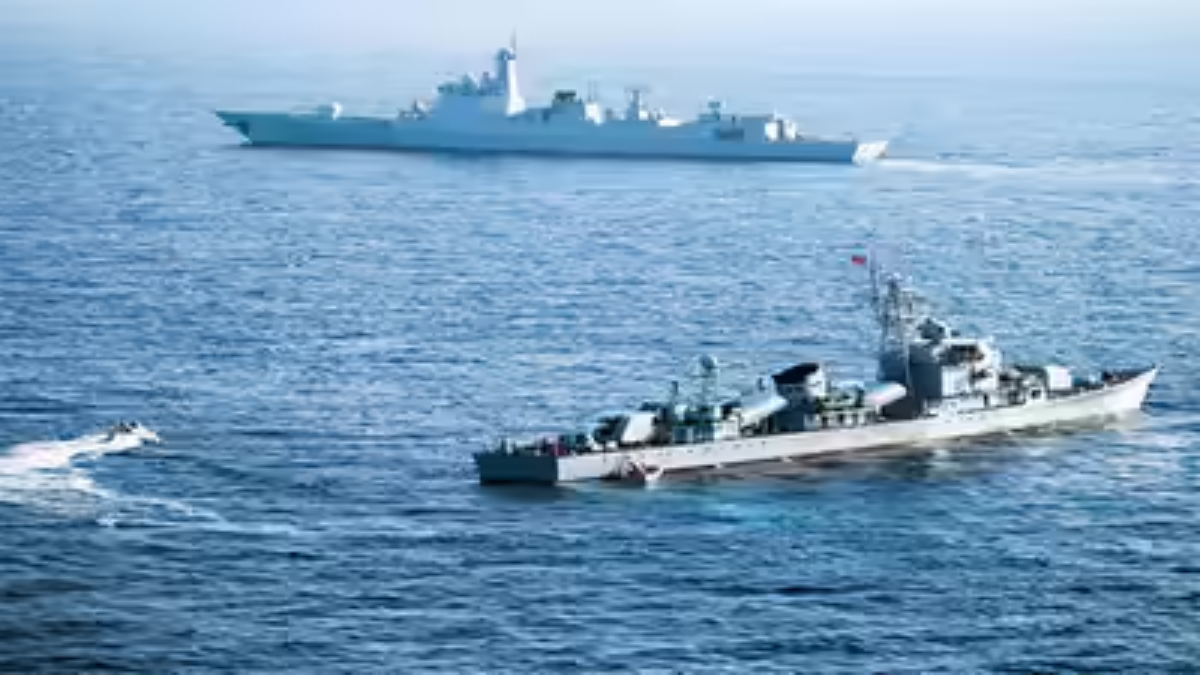
The South China Sea is one of the world's busiest maritime corridors, carrying roughly one-third of global seaborne trade each year. China claims most of the waterway through its controversial "nine-dash line," a claim that overlaps with those of the Philippines, Vietnam, Malaysia, Brunei and Taiwan.
The arbitration case, initiated by the Philippines in 2016, concluded that China possessed no historic rights over resources within the nine-dash line and that several of its actions breached UNCLOS. Although the ruling is legally binding, Beijing has refused to recognise it and has continued expanding its military and coast guard presence throughout the disputed region.
Also Read | US revives Russia sanctions push, putting India under renewed 500% tariff threat