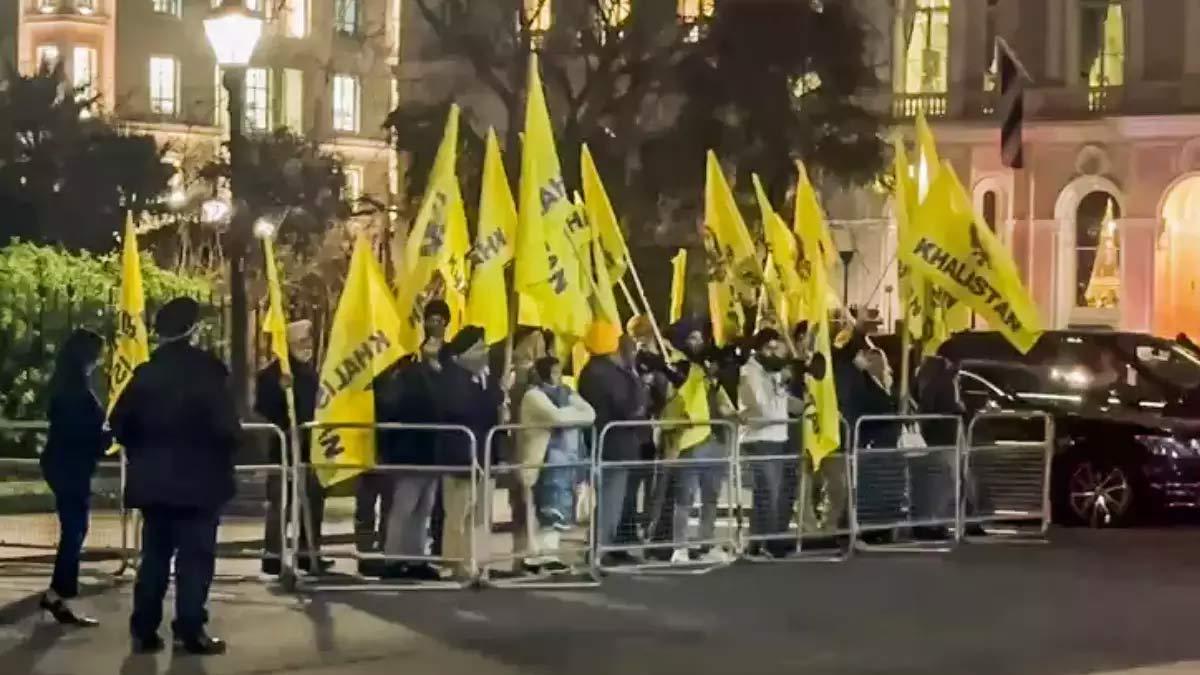


A recent Canadian government report has validated that Khalistani radical groups remain active and raise funds in Canada, mirroring India's long-standing concerns regarding pro-Khalistani elements utilizing Canadian soil to pursue anti-India interests.
The report, 2025 Assessment of Money Laundering and Terrorist Financing Risks in Canada, particularly identifies Babbar Khalsa International and the International Sikh Youth Federation as recipients of Canadian-source funds.
“Khalistani extremist groups supporting violent means to establish an independent state within Punjab, India, are suspected of raising funds in a number of countries, including Canada,” the assessment states.
It puts Khalistani extremists under a wider umbrella known as Politically Motivated Violent Extremism (PMVE). The report states that this type of extremism "encourages the use of violence to establish new political systems, or new structures and norms within existing systems."
“While PMVE may include religious elements, actors are more focused on political self-determination or representation, rather than racial or ethnic supremacy,” it adds.
The Canadian government has included these Khalistani groups on the same list as Hamas and Hezbollah, noting that all have "been found by law enforcement and intelligence agencies to receive funding that originates in Canada."
The report also points out that while Khalistani organizations had vast fundraising networks in Canada previously, they now seem to be functioning in small cells of dedicated people.
India has not yet commented on the findings. The evaluation outlines how these entities fund their activities. Hamas and Hezbollah, for instance, "utilize various funding techniques to support their activities, including MSB and banking sectors abuse; use of virtual currencies; state sponsorship; abuse of the charitable and non-profit organizations (NPO) sector; and criminal activity."
which warned that “since the mid-1980s, the PMVE threat in Canada has manifested primarily through Canada-based Khalistani extremists seeking to use and support violent means to create an independent nation state called Khalistan, largely within Punjab, India.”
These conclusions are supported by a June 18, 2024 report by the Canadian Security Intelligence Service (CSIS), which also noted that since the 1980s, "the PMVE threat in Canada has manifested primarily through Canada-based Khalistani extremists seeking to use and support violent means to create an independent nation state called Khalistan, largely within Punjab, India."
The release of the report comes at a sensitive juncture in India-Canada relations, which reached a low point in September 2023 after then-Canadian Prime Minister Justin Trudeau accused India of involvement in the killing of Khalistani terrorist Hardeep Singh Nijjar on Canadian soil.
New Delhi rejected the claim as “absurd and motivated,” sparking a diplomatic standoff that led both countries to withdraw their envoys.
Relations have since improved after Mark Carney took Trudeau's place and promised to take action against India's grievances. Though envoys have returned, concrete action against Khalistani outfits in Canada is still pending.